Every newsroom knows the moment. A wire alert lands, the story shifts, and someone has to tell the social desk, the producers, the graphics team and the web editors. By phone, by Slack or by shouting across the entire newsroom.
The Story Object Model (SOM) aims to retire that routine for good. Launched at IBC in September by a group of broadcasters and vendors, it gives every tool in your newsroom the same shared understanding of a story as it unfolds. It’s easy to see why we can’t stop talking about it, right?
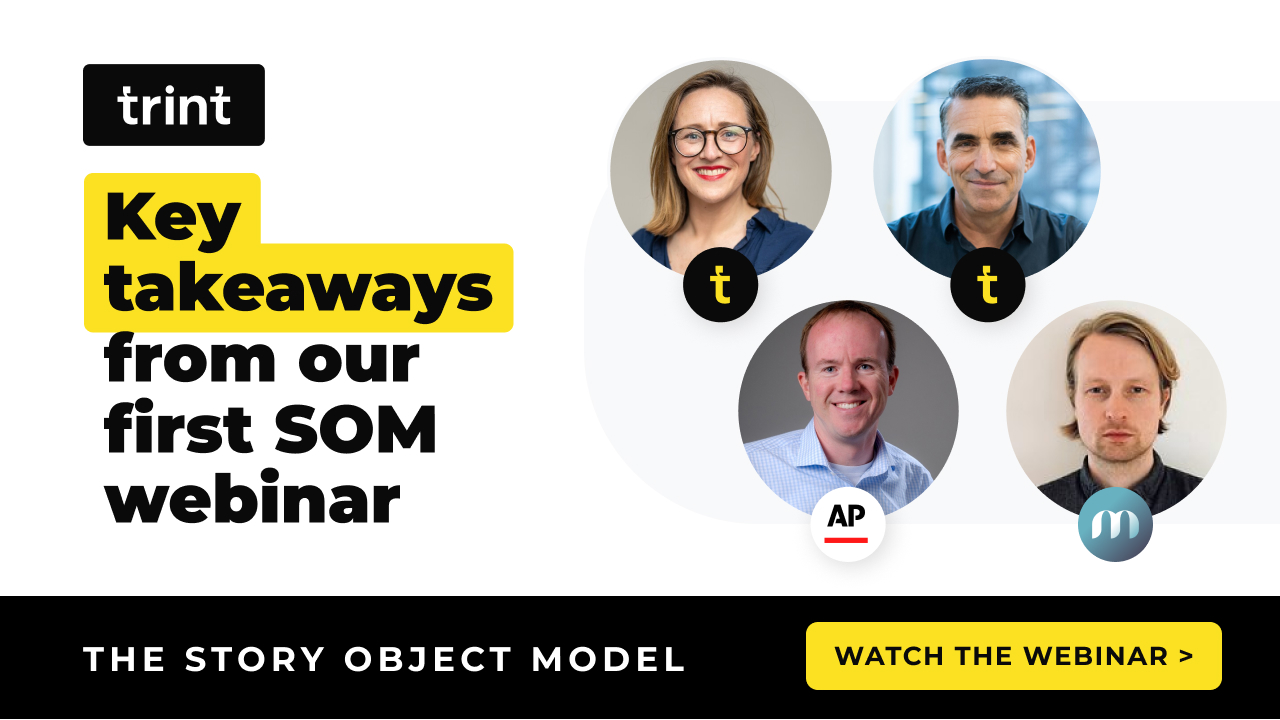
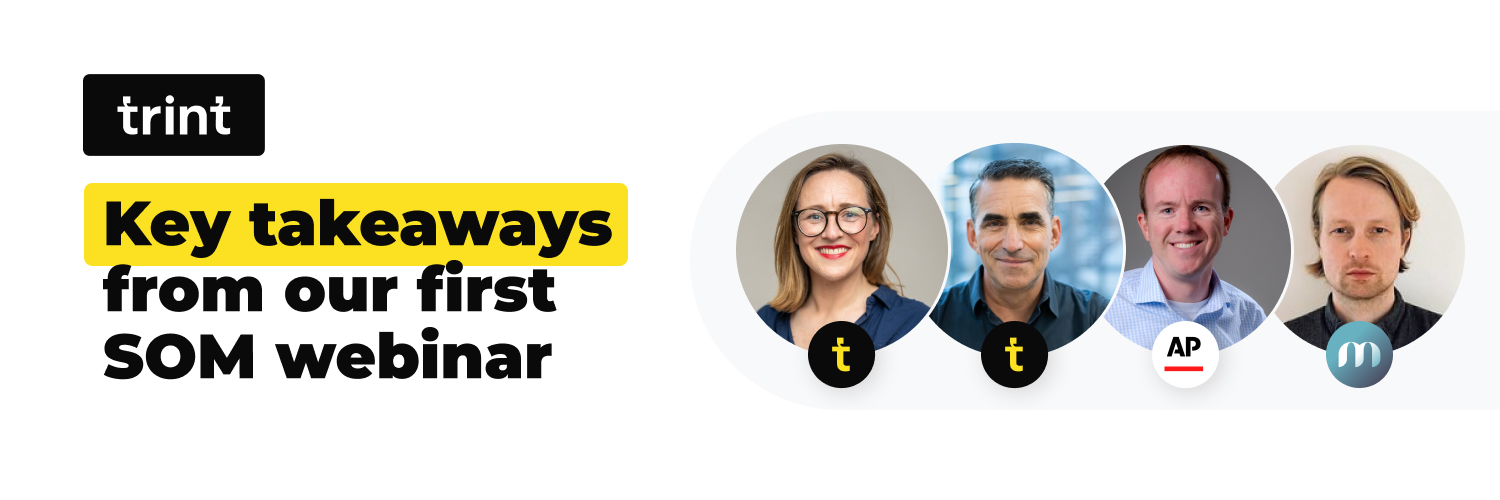
That’s also why, on November 11, we hosted the first in our two-part SOM webinar series to unpack what it means for newsrooms. Trint’s Founder and CEO Jeff Kofman was joined by Brian Hopman, VP of Workflow Solutions at AP, Árni Geir Úlfarsson, Senior Software Engineer at Mimir and Trint's VP of Product, Tessa Kaday.
Brian opened with the pain point anyone who's worked a breaking story will recognize. News arrives fast. The footage and the transcript arrive with it. But the meaning around them, like what's confirmed, what's in doubt and what an editor has signed off on, travels by phone call, online messages and quick in-the-room chats. This means a producer downstream might have the media without knowing the latest editorial decision.
"Our problem isn't that the journalists don't understand the stories. It's that the technology doesn't consistently share that understanding. That’s the gap that SOM sets out to close."
~ Brian Hopman, AP
SOM is not an AI model, something you buy, or a replacement for your newsroom system or your fact checkers. Árni gave us the clearest comparison of the session: think about email.
"If you imagine something like email, the standard is SMTP. You have products like Gmail or Outlook. You have infrastructure like mail servers. And nobody owns it. SOM is a little bit like that."
~ Árni Geir Úlfarsson, Mimir
In practice, SOM is an open, shared language for live editorial context that sits beneath the tools you already use. Each tool connects to the SOM "bus": a shared channel where any system can post an update and every connected system hears it. As Árni put it, you shout a message out, and everybody who's listening can hear it. The upside for newsrooms is clear. Instead of every vendor building a one-off integration with every other vendor, each tool integrates once and can talk to all the rest.
Tessa spoke in depth about why SOM matters for AI tools in particular. Trint can already watch a live feed and surface the quotes that match a prompt. That's great for one person on one transcript. But on a breaking story, across a whole newsroom, the AI needs to know how the story is developing and what every other tool is doing.
"The reality is we all use Claude and ChatGPT, and we know the quality of the output relies on the depth and quality of the context you give the tool. We're suddenly supercharging all of our tools with this knowledge."
~ Tessa Kaday, Trint
In short, SOM turns a smart demo into something you can actually run at scale.
A shared standard doesn't mean shared editorial standards. Brian made a clear point that the language is common, but the rules that sit on top of it belong to each organization. Those rules, which Brian called the "skills layer", stay with AP or whichever organization is running it.
"Reuters or AP might have really strict standards on how information moves through the gate, while someone else may want to move really aggressively. SOM makes room for all of that. It does not dictate what anyone's standards should be."
~ Brian Hopman, AP
The same goes for deciding which stories make it onto the bus at all. Early on, the teams behind SOM considered letting every wire alert create a story automatically, but quickly realized that would overwhelm everyone (systems and humans). Whether a story gets added remains a human call, or a rule your newsroom sets for itself.
One audience question prompted a great discussion and further insights from the panel: “Can SOM address the risk of duplicated stories from a large news organization?” The answer was yes, and Jeff explained why.
“Part of the workflow that makes SOM so interesting is that you should never have two versions of the same thing. Yes, you can have individuals with transcription tools, but if they don’t talk to each other, you’re going to be transcribing the same things six, ten times over. You want to have a single source of truth for everything and one place to go.”
~ Jeff Kofman, Trint
Tessa then flipped the question around to re-versioning, one of the most laborious jobs in any newsroom.
"When I need to do a social post or a video, I need to do it in four different languages. If one piece of information changes, the death toll changes or a soundbite needs correcting, managing all of those versions can be really laborious."
~ Tessa Kaday, Trint
The answer: lighter than you might think. "We joined this effort quite late, to be honest, and to get everything up and running for us, it was quite easy. We didn't have to make any changes inside our own product," said Árni. Jeff also shared a story from a recent trip to Berlin, where a senior engineer at a large German news organization that wasn't part of the project read the specs and built a working version on his own in just a day. That shows not only how innovative the standard is but also how accessible SOM can be.
As for where things stand now: the 1.0 specification and schema were released at IBC 2026 and have been shown working with products from more than a dozen companies. SOM isn't running in live newsroom production yet, but that's something we expect to change soon.
The big open question, as Tessa mentioned, is the "control plane": an easy way for organizations to set their editorial rules, choose which vendors join the bus and decide how approvals fit into tools they already use. She called it “one of the juiciest problems for the next stage”.
To close off the webinar, Jeff asked the panel to look two years ahead, asking “what separates a newsroom running SOM from one that isn't?”
Tessa said it came down to speed, scale and trust. Publishing across so many platforms, at pace, is now core to success in the news industry. SOM lets newsrooms automate that work safely, with every step on the record.
"If our production processes are going to be a combination of machines and humans, we need a really clear and easy way to track what humans have done and what machines have done."
~ Tessa Kaday, Trint
That audit trail is what lets journalists hand the copy-and-paste work to machines and spend their time on the parts of the story that need them. And because SOM is an open standard, newsrooms don't carry the cost and risk of building it all alone.
Webinar one covered the why. Webinar two gets into the how.
On Thursday, November 19 at 11:30 a.m. ET / 4:30 p.m. GMT, we're joined by experts from Octopus Newsroom and LiveU, two of the products you saw working together in the IBC demo, for a conversation about putting SOM to work and the future of integrated newsroom tools.
Whether you're weighing SOM for your own newsroom or just want to know what all the IBC buzz was about, come along, bring your questions and invite a colleague.
Register for the next webinar here
Can't wait until then? Explore the spec, demos and ways to get involved at storyobjectmodel.com.