Transcription has been part of newsroom life for years. But the way teams use it is changing fast. It’s no longer a tool for one producer with one interview, but something whole organizations rely on, often live, and often daily. That’s putting new pressure on the basics, while opening up new ways for transcripts to work harder than ever before.
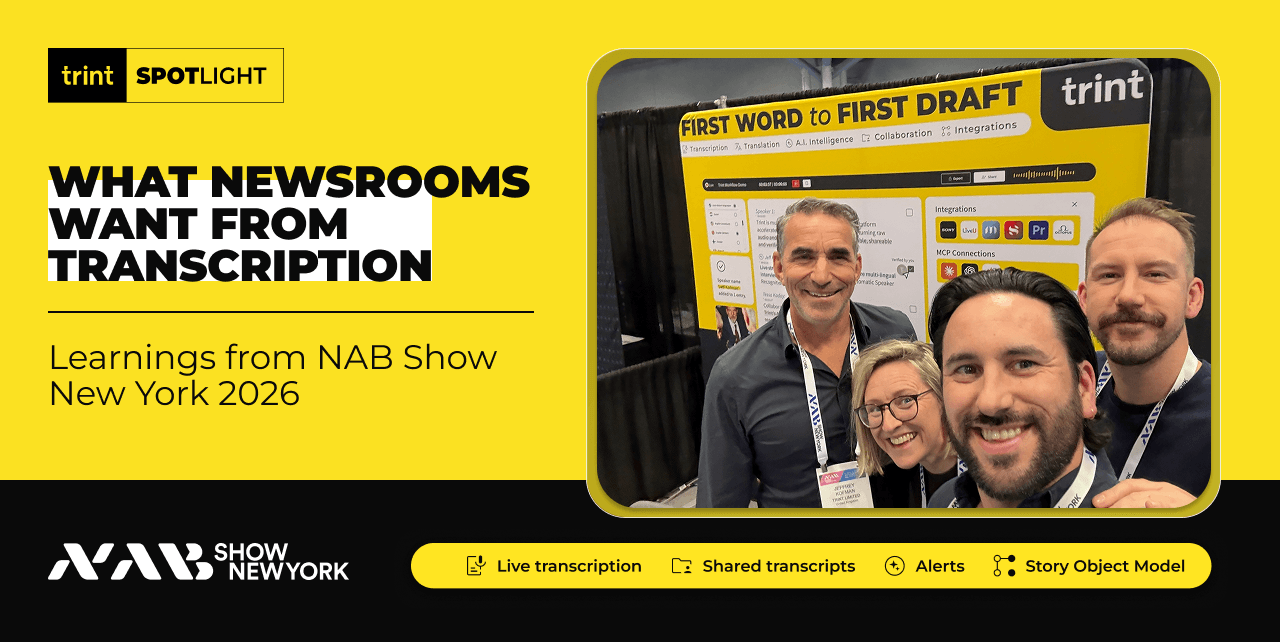
Last week some Trint faces you may know by now – Jeff Kofman, Tessa Kaday, Kev Olden and Josh Morrow – descended on the Big Apple. Between customer meetings (in some of the biggest newsrooms in the country), catch-ups with partners and two busy days at NAB Show New York, the team brought back some big lessons about where transcription is heading.
If there is one thing every newsroom agrees on, it is this: the more people rely on AI transcription, the more the fundamentals matter. That means accuracy, speaker detection and reliable live transcription aren’t just nice-to-haves when a lot of people are working from the same transcript. Broadcasters want to know that transcription and speaker diarization will capture speakers right the first time.
Live transcription is now part of how many newsrooms cover breaking news every day. As it scales, expectations are rising. Our conversations touched on the need for longer live sessions where nobody is worried about hitting a limit halfway through their session and where timecodes can be taken straight from the live feed. Now, the focus is getting live transcription faster and scaling it across every workflow.
One of the biggest shifts we are seeing is in who wants to see a transcript: it’s no longer just the people who create them. Newsrooms want those transcripts, especially live ones, to reach everyone in the organization.
One global news organization told us about a common problem related to this: the press conferences their video team is already transcribing aren’t being shared with text reporters who need them. Because of that some of their journalists are still capturing what was being said by propping their phones against the TV screen. It’s a clumsy workflow that is easy to close if your transcription tool allows easy sharing and smarter permissions that reach across the whole organization, so a transcript made by one team is useful to everyone who needs it. Trint does that.
Nobody has time to watch a transcript all day. Across broadcasters and news agencies, the request is the same – let people know when a transcript is ready and when something important happens. Trint’s AI assistant can do that.
And the promising new experimental integrated workflow framework called Story Object Model will take it much further. Newsroom professionals want the information they need without having to keep an eye on a live feed. With Story Object Model, some newsrooms are exploring building their own monitoring and breaking news tools using live Trint transcripts as a valuable source to feed them. That means getting the right moment to the right people, inside the tools they’re already using.
Speaking of the Story Object Model, since we helped unveil SOM at IBC in September, curiosity has only grown. In New York, we fielded questions about SOM with customers, partners and companies we’d previously never spoken to.
With AP and LiveU, we’re now exploring how to put the SOM experimental framework to work in a real newsroom, going well beyond a show-floor demo. We are seeing longtime partners asking to do more together, and new companies approached us looking for ways to have Trint’s transcription and metadata inside their own products.
What ties it all together is trust. The newsrooms we meet want an innovation partner and AI systems that work for them, with a clear view of what they are doing and why. That’s what the Story Object Model is built for, and how we’ll keep building and innovating Trint going forward.