For decades, the newsroom mantra was simple: break the story first. Be the first on the scene. Get the quote. Beat your competitors to publication before they’ve even found their headphones and opened their news production software.
But AI content is changing all that. Now, anyone with a generative AI tool, a social account and questionable motives can create hyper-realistic synthetic videos or images in a few clicks. Then publish anonymously at scale.
Misinformation on the internet is nothing new (remember the chain emails and digital hoaxes of the 90s and early 2000s?). But generative AI has changed the economics and scale of the problem. Fabricating convincing content used to require time, money or at least some technical skill. Now it just takes a prompt and about eight seconds of patience — assuming there's even a real person involved at all.
For newsrooms already balancing shrinking revenues, audience fragmentation and an always-on news cycle, this is another challenge they didn't need. The volume of misleading content is growing faster than human teams can investigate it. Verification lag — the widening gap between information appearing online and journalists being able to authenticate it — is becoming one of the defining editorial challenges of our AI era.
But where there's journalists and coffee, there's hope. The same technology that's being used to flood the internet with misinformation may also help news organizations fight back. When deployed by skilled journalists and news organizations, AI assistive tools can help professionals to verify faster. Then bring the real story to broadcast, before the news cycle moves on to the next thing.
While this technology isn't anything brand new, what’s changed is speed, scale and integration. Live transcription, searchable archives, instant playback, multilingual workflows and collaborative editing tools are turning transcription from an admin task into vital verification infrastructure.
In this article, we'll take a closer look at how the misinformation economy has changed journalism, and how AI transcription tools could help newsrooms fight back.
The new misinformation economy
There was a time when audio and video carried a built-in assumption of authenticity. Grainy footage might be low quality, but people still largely believed what they were seeing and hearing. Especially if it was validated by a trustworthy news outlet.
That assumption no longer holds. Now, hyper-realistic synthetic images, voices and deepfake video can be created at scale. Some are obvious, but others are convincing, even to an experienced journalist.
We’ve already seen how quickly this type of synthetic media can have real-world impact. In 2023, an AI-generated image showing a fake explosion near the Pentagon briefly rattled financial markets after spreading rapidly across social media (AP). Meanwhile, AI-generated political imagery and voice cloning have become recurring problems during election cycles and major global events.
The challenge for newsrooms is not simply that this kind of misinformation exists. It’s also that the volume and speed of synthetic content are overwhelming traditional verification processes.
A manipulated image can spread globally before editors can geolocate and verify the source. Or a fabricated quote can make a splash on socials before reporters locate the original speech. Misinformation can shape public perception long before corrections catch up.
This is bad for audiences and democratic discourse. But it also presents a very immediate business and logistics headache for newsrooms.
Why verification lag is now a newsroom business problem
Misinformation is often framed as mainly a social or political problem. But for publishers, broadcasters and media organizations, it’s increasingly an operational and commercial problem too. Here's how the verification crisis is currently unfolding.
Step 1: Blurred lines erode public trust in news
Even without an onslaught of misinformation, many modern audiences are already primed to distrust institutions. According to research from Gallup, confidence in mass media has declined significantly in recent years, reaching a new low in 2025.
As synthetic content continues to saturate feeds, audiences are increasingly doubting everything they see online. The result is a kind of informational exhaustion. Audiences become overwhelmed, skeptical and detached, leaving us with what UNESCO calls a 'crisis of knowing'.
And there is little sign of that pressure easing. Research from the Pew Research Center shows that half of U.S. adults believe AI will have a negative effect on news over the next two decades.
Step 2: AI slop makes verification harder than ever
Modern newsrooms operate inside a constant stream of live information: social posts, livestreams, eyewitness footage, leaked audio, wire updates and user-generated content arriving simultaneously across platforms. Teams are expected to authenticate material in minutes while competitors race to publish first.
The pressure to publish quickly only makes this harder. That creates the perfect conditions for mistakes, setting trust back even further.
In the age of AI slop, even small editorial mistakes can become major reputational events. A misquoted source, an image published before full verification or a selectively edited clip (as the BBC recently learned to its cost) can have huge implications.
Step 3: Revenue takes a hit
Generative AI has lowered the cost of producing low-quality content to almost zero, meaning content farms can flood search engines and social platforms with optimized articles designed purely for traffic. Even when audiences recognize the content is poor, it still competes for attention, ad space and search visibility — hitting legitimate publishers in their pockets.
At the same time, declining trust undermines newsroom economics from another direction. If audiences stop believing a publisher is reliable, they stop engaging. And that means fewer clicks, fewer subscriptions and fewer print sales.
That creates a feedback loop. Revenue pressure forces newsrooms to do more with smaller teams. Smaller teams increase the risk of rushed or incomplete verification. And rushed verification increases the likelihood of costly mistakes, which further erodes trust. The cycle repeats and each turn makes it harder to break.

Verification as a competitive advantage: how newsrooms are taking a stand
What's becoming clear is that the organizations most likely to survive the AI misinformation era will not necessarily be the fastest publishers. They’ll be the organizations capable of reducing verification lag without compromising editorial standards.
If the old newsroom race was about publishing first, the new race is about verifying first. And this shift is already reshaping how major news organizations operate.
In 2023, BBC Verify launched as a dedicated unit focused on tackling misinformation and demonstrating editorial rigor in real time. By geolocating footage, examining metadata and analyzing audio patterns, the team works to expose manipulated or AI-generated content and identify those behind it.
This important work shines a light on how high editorial standards and creative, rigorous investigative practice can still win against even the most convincing AI chicanery. But it also raises another question: how do newsrooms maintain that level of scrutiny at the speed the modern news cycle demands?
This is the core challenge of verification lag.
Verification cannot become a bottleneck that leaves trusted organizations permanently trailing behind misinformation campaigns and algorithmic junk content. Newsrooms need systems that allow reporters, producers and editors to authenticate information while stories are still developing, not after the internet has moved on. And this is where AI transcription tools come in.
How AI transcription is helping newsrooms fight misinformation: six use cases
Transcription software used to be seen mainly as a productivity tool. A neat time-saver that spared reporters from manually typing up interviews in the small hours when a deadline was closing in.
But in today’s verification crisis, AI transcription has a much bigger job to do. It’s becoming part of the infrastructure that helps newsrooms protect accuracy and maintain editorial integrity under extreme pressure. Tools like Trint are now embedded in verification workflows, enabling faster collaboration while also building searchable institutional memory in the background.
For newsrooms dealing with misinformation, fragmented workflows and a cut-throat news cycle, that edge can be make or break.
Here are six real-world ways AI transcription is being used in the fight.

Win the race to verify first
Anyone can publish quickly, but the challenge is publishing trustworthy content fast. When a story breaks, multiple teams have to work simultaneously: reporting, production, social publishing and live coverage. Everyone needs accurate information immediately, and there is very little room for friction.
Traditional workflows struggle under that pressure. A reporter hears a potentially explosive quote and producers scramble to replay the audio. Meanwhile, social media has already decided what was said minutes ago.
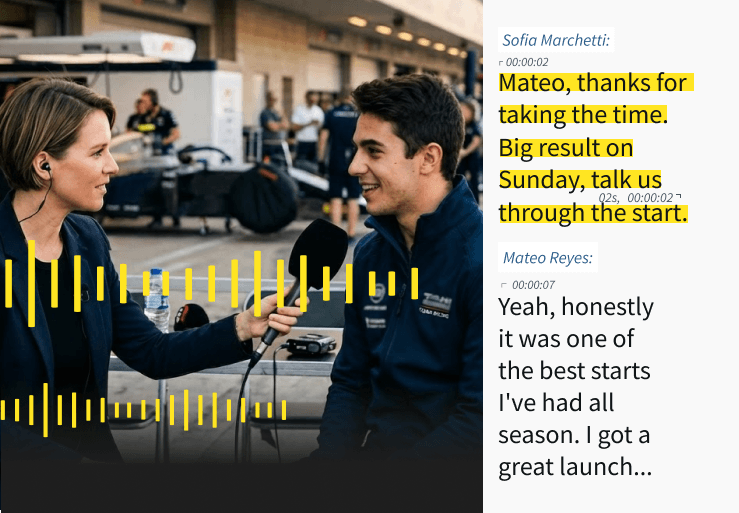
Live transcription removes much of that bottleneck. With near real-time live transcription, searchable text appears almost instantly during live events, interviews or broadcasts. Reporters in the field, editors in another office and producers in the control room can all work from the same source material at the same time. Instead of waiting for recordings to upload or interviews to finish, teams can verify quotes while events are still unfolding. Journalists can instantly rewind transcript-linked audio to confirm context, tone or wording before publication.
A clipped sentence without context can fuel misinformation. A searchable live transcript makes it much easier to confirm what was actually said before excerpts circulate online, detached from the original context.
And because platforms like Trint support multilingual transcription and translation, global teams can collaborate in real-time, even when speakers switch languages mid-stream. That’s increasingly essential in international reporting environments where misinformation moves faster than manual translation.
Accuracy without slowing down production
Good journalists don't publish inaccurate information because they don't care about standards. More often, mistakes happen because teams are overloaded, fragmented or working against impossible timelines. Bad workflows are usually the culprit.
Misquotes are a perfect example. A single sentence pulled from a fast-moving interview can completely alter the framing of a story if context is lost or wording is slightly wrong. Political reporting is particularly vulnerable here because partial clips and selective edits spread rapidly online.
AI transcription helps reduce those risks by making verification easier. When combined with thorough human oversight, journalists can create highly accurate transcripts in a fraction of the time that manual transcription would take.
Take Trint, for example. Our timestamped transcripts allow journalists to quickly replay and verify moments without digging manually through recordings. Because the text can be searched like any other doc, teams can easily locate key quotes across lengthy interviews and live events. Trint’s AI live highlighting feature can pick out relevant moments as they are spoken, providing reasoning behind the choice, before users verify and confirm the content. Our custom dictionary feature means that unusual terms, slang or accents don't create accidental mix-ups, either.
Optimising for engagement
To compete with AI junk, news providers have to create stories that will stop users mid-scroll. One way to achieve this is to make sure all content is optimized for engagement and accessibility via captioning. Large portions of social video consumption now happen without sound, and captioning is essential for ensuring that content is truly accessible to all audiences.
Accurate subtitles also help audiences understand context more clearly — and that's a powerful tool in the fight against misinformation. A verified quote attached directly to original footage is much harder to manipulate than isolated text circulating online, for instance.
With automated captioning software, newsrooms can do all of this without slowing down the content pipeline. Check out our guide to increasing engagement using captions to learn more.
Scaling content and opening new revenue channels
Transcription also helps publishers scale content and find new monetization opps. A single audio or video interview can quickly become:
- a written article
- social clips
- subtitled video
- newsletters
- podcasts
- short-form explainers
In an industry where budgets are constantly being squeezed, maximizing the value of original reporting can make a serious impact on a newsroom's bottom line.
Global reach and multilingual journalism
Misinformation is global, so verification increasingly needs to be as well. Stories now spread across languages and regions almost instantly, particularly during elections, conflicts and major international events. But many newsrooms still face significant resource constraints when it comes to translation and localization.
AI-assisted translation can help close that gap. Multilingual workflows allow journalists to quickly transcribe interviews, speeches and events across dozens of languages, making it easier to verify claims without relying entirely on manual translation pipelines. Subtitles and translated captions also help publishers reach broader audiences directly on social platforms where discoverability often depends on accessible, localized content.
Fast, accurate localization also helps to reduce informational asymmetry. False narratives often spread fastest in spaces where verified reporting is delayed, inaccessible or unavailable in local languages. AI-assisted localization helps trusted organizations establish factual reporting earlier in the conversation, stamping out the bots and bad actors before they start.
Searchable archives become institutional memory
This may be one of the most overlooked advantages of AI transcription in journalism. News organizations sit on enormous amounts of historical audio and video content: think interviews, press conferences, field recordings, raw footage, documentaries, podcasts and unused clips.
All of these resources can too often disappear into archives, creating a form of newsroom dark data. Valuable reporting exists, but nobody can realistically search for it.
Our audio and video transcription changes that by enabling teams to build digital text archives. Journalists can quickly locate previous statements, identify contradictions, revisit historical context and surface forgotten reporting relevant to breaking stories. Editors can cross-reference claims against years of prior interviews in seconds rather than hours.
That transforms archives from passive storage into valuable verification infrastructure. It also strengthens institutional memory at a time when many newsrooms face staff turnover, shrinking teams and increasing production demands.
Text-based archives offer another strategic advantage. Many organizations are now exploring proprietary AI systems trained on trusted internal data rather than open web content. Searchable transcript archives provide high-quality structured datasets grounded in verified reporting rather than scraped internet noise.
These can be used to build secure, effective and personalised internal AI workflows without exposing sensitive IP or source material on the wider internet. In time, these could even become saleable proprietary AI news production tools. In the long term, archival data may become one of the most valuable assets a newsroom owns — and it's already right there in your hard drives.

Human-led AI wins trust
There is currently a strange contradiction in the media industry. At the exact moment audiences are becoming more skeptical of AI-generated content, some organizations are rushing to automate more editorial workflows.
That approach carries risks, especially in terms of public trust and data security. Trust is not an abstract journalistic value: it's the product that newsrooms are selling. That’s why the most effective newsroom AI strategies are increasingly human-led rather than fully automated.
The goal is not removing journalists from the process. It’s removing repetitive friction so reporters can spend more time verifying facts, investigating claims and telling accurate stories. In other words, AI should handle the tedious parts, while humans should handle editorial judgment. That balance is increasingly becoming the defining principle of responsible newsroom AI adoption.
One organization that's already taking steps in this direction is Agence France-Presse. AFP isn't just using Trint's AI transcription software to cut the charge mentale (that's mental load) of typing up footage and audio. It's also using it to double down on human-led verification practices and on-the-ground journalism.
At Agence France-Presse, leaders have emphasized that there is no "magic bullet” for AI verification. Tools can assist, accelerate and support. But editorial responsibility still belongs to journalists.
Why data security builds trust
Security and governance matter too. Many free-use AI tools train on user prompts and uploaded data. For journalists handling embargoed stories, confidential interviews or sensitive source material, that creates obvious risks. Read our guide on mitigating AI security risks to learn more.
Newsrooms exposing transcripts, recordings or source information to unsecured systems risk far more than embarrassment. They risk legal exposure, source compromise and long-term reputational damage. Ironically, the same organizations trying to fight misinformation can accidentally weaken trust themselves if they adopt insecure AI workflows without proper governance.
Newsrooms need far stricter standards when vetting AI tools than other, lower-risk, industries. That means choosing enterprise-grade platforms built for journalism, with robust access controls, secure infrastructure and regional data storage options. Because the time saved by insecure AI workflows quickly disappears when sensitive data, sources or editorial credibility are put at risk.

Why newsrooms are turning to Trint
Trint was built by a journalist, for journalists — not retrofitted from a generic AI productivity tool. Designed around real newsroom workflows, it brings reporting, verification and publishing together in one secure platform.
Generate transcripts in seconds, then use Story Builder to edit, playback and verify key moments collaboratively. Teams can comment, highlight and share feedback in real time, even with external contributors.
And because security matters as much as speed, Trint offers enterprise-grade protection including ISO 27001 certification, EU or US data storage options and a commitment never to train models on your transcripts.
With transcription in more than 50 languages and translation in over 70, Trint helps global newsrooms verify and publish faster across borders. Our AI Assistant can also summarize transcripts, surface key quotes and help shape first drafts, reducing admin without replacing editorial judgment.
Trusted reporting still matters — now more than ever. If your newsroom is ready to reduce verification lag, strengthen editorial workflows and fight misinformation without sacrificing speed, speak to the Trint team.
With flexible subscription models, enterprise-grade security and seamless integration, Trint helps journalists spend less time chasing transcripts and more time reporting. Book your demo to see exactly what Trint can do for your organization today.




Jeff Kofman

DON'T take our word for it
Download our eBook, Telling Stories Faster With Trint, and hear how Trint is making content creation faster, easier and, most importantly, painless for newsrooms across the world.
Download
What Is an SRT File & How Do You Create One?

Closed Captions vs Subtitles for Accessibility