
How to mitigate AI security risks: why free AI transcription tools put your business at risk

AI transcription is transforming how organizations capture and use information. From boardrooms to newsrooms, it turns meetings, calls and interviews into searchable, actionable records — quickly, accurately and without the grind of manual note-taking.
But here’s the catch: not all AI tools are made alike. "Free" or poorly designed solutions can quietly turn your confidential information into someone else’s training data. That’s not just a privacy risk — it’s a reputational, financial and legal headache waiting to happen.
In this article, we’ll explore the sector-specific risks in media, legal, finance and beyond. Then we'll lay out a roadmap for safely adopting AI without compromising one of your organization's most valuable assets: your information. By the end, you’ll understand how to get the benefits of AI transcription while keeping your data under your control.
Why 'free' doesn't always mean free
You've probably heard the saying, “if you aren’t paying for the product, you are the product”. This is true of many AI tools that are marketed as free to use. These tools may harvest your data to train and improve their models, putting your sensitive conversations at risk. But why do they do this and why is it risky for businesses?
To understand this, you need to have a basic grasp of how AI transcription works. It's a little complicated, but we'll keep it simple.
How AI transcription and data training work
At its core, AI transcription converts audio and video into written text using machine learning and speech recognition.
- Audio capture: The system receives your recording or live stream and breaks it into small segments. It identifies speech, separating it from background noise.
- Speech recognition: The model has been trained on massive amounts of audio, learning how sounds map to words. This training lets it handle accents, speaking styles and varying clarity.
- Language modelling: The system analyses word sequences to pick the most likely interpretation, distinguishing similar-sounding words based on context.
- Post-processing: Top-tier systems can add punctuation, label speakers, apply timestamps and optionally clean up filler words, making transcripts readable and searchable.
Why tools that train on user data expose your business to risk
So, AI transcription systems need data — lots of it. To improve accuracy, most models are perpetually hungry for more and more data. Where does that data come from?
- Public datasets: Volunteer voice recordings and open-source collections help models learn general speech patterns, accents and languages.
- Licensed proprietary audio: Some vendors rely on commercially licensed recordings from media, broadcasts or curated speech corpora.
- User-generated data: Here’s where risk creeps in. Certain tools use your audio and transcripts to train their models. That means private meetings, client calls or sensitive interviews could feed someone else’s AI.
In short, free tools often feed your data back into the model, turning your confidential conversations into someone else’s learning material. In other words…you become the product.
What are the risks?
Data privacy and confidentiality
Meetings, calls or strategic discussions could be exposed internally or used to train a provider’s AI models. For organizations handling client data, legal advice, IP or sensitive strategy sessions, this is a serious concern.
Compliance and legal issues
A data breach via a free-use tool could put you at risk of violating regulations like GDPR or HIPAA. Processing sensitive information without clear consent or sending data across jurisdictions can also create compliance headaches.
Intellectual property exposure
Even “anonymized” information can influence AI models and outputs. That raises concerns about losing control over proprietary content and potentially giving competitors an edge.
Security vulnerabilities
Your transcription data can be an attractive target for attackers. Breaches, weak API integrations or poor infrastructure could leak sensitive transcripts, creating reputational and financial damage.
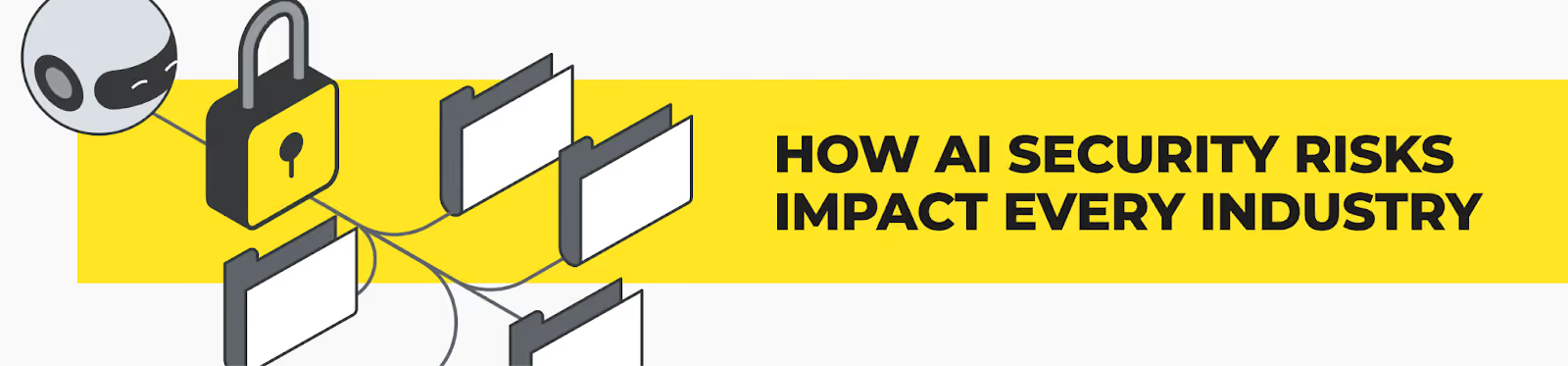
How AI security risks impact every industry
But these risks aren't universal. Each organization faces unique challenges depending on the type of data handled, regulatory requirements and operational sensitivities.
Understanding these sector-specific risks is critical for making informed decisions about which transcription tools to trust with sensitive information.
Journalists
For newsrooms, AI transcription is an increasingly essential tool. However, while it greatly speeds up reporting and content creation, using free or insecure tools risks exposing confidential sources, leaked documents or unpublished investigations. A compromised transcript could endanger whistleblowers, tip off subjects of investigations or undermine press freedom. Even the perception of poor data handling can erode public trust, damage credibility and dissuade sources from coming forward.
In an era where government access to data is increasingly scrutinized, journalists need transcription solutions that allow them to work without the threat of exposure.
Legal professionals
Attorney-client privilege is sacred. Transcripts from depositions, client calls or strategy meetings often contain sensitive information — from case strategies to settlement negotiations. Using AI transcription tools that store or repurpose data can risk inadvertent disclosure, regulatory penalties or even malpractice claims. Even a minor breach can compromise litigation strategy, violate GDPR or HIPAA requirements and erode trust between clients and counsel.
Sports organizations
AI transcription tools can expose competitive intelligence. Recordings of team meetings, strategy sessions or exclusive interviews may contain confidential information about contracts, talent evaluations or negotiations. Leaks can breach exclusivity agreements, reveal insider insights to rivals or result in IP theft. For organizations competing in fast-moving sports markets, even a single compromised transcript could influence sponsorship deals, trades or broadcast rights.
Corporations
Transcripts from internal meetings, executive calls or R&D sessions often contain trade secrets, merger and acquisition plans or strategic initiatives. Storing these on unsecured or “free” AI platforms risks leaks that could derail acquisitions, damage stock prices or compromise competitive advantage. Beyond these financial risks, mishandling sensitive internal communications threatens professional reputations, especially for senior leadership.
Content creators
Podcasters, video producers and writers risk losing control of intellectual property when using transcription tools that feed data back into AI models. Scripts, storyboards or creative content could be incorporated into broader datasets, potentially appearing in other works without permission. For creators, this presents a threat not just to privacy, but originality and revenue streams, too.
Education and researchers
Transcripts of lectures, interviews or qualitative research may contain proprietary methodologies or sensitive participant information. Free AI tools can inadvertently expose studies, participant identities or confidential findings. In regulated fields like healthcare or social research, this could violate consent agreements, academic standards or legal protections, compromising credibility and the safety of research participants. And this in turn poses a risk to the academic reputation of the wider faculty, too.
The financial case for secure enterprise-level transcription
Investing in secure, enterprise‑grade AI transcription isn't just about keeping legal and IT teams satisfied. It’s also a sound financial decision.
Free or consumer tools may look cheap upfront, but this can be a false economy. When sensitive data is mishandled — whether through insecure storage, third‑party training or lax access controls — the financial fallout can be severe.
Take the password manager LastPass, which was fined £1.2 million ($1.6 million) by the UK Information Commissioner’s Office after a security breach exposed personal information of up to 1.6 million users (Forbes). Regulators found that inadequate organisational and technical measures contributed to the compromise and the fine was imposed to reflect the company’s failure to protect user data. While LastPass later improved its security posture, the penalty and associated reputational damage were significant. What's more, it would have been entirely preventable with stronger controls.
Reputation matters. It takes years to build trust with customers, partners and markets. A single security SNAFU tied to a weak transcription tool can undo that work overnight, eroding confidence and reducing long‑term revenue potential.
Continuity of support is another practical advantage of enterprise‑ready solutions. Free tools might one day abruptly change their terms of service or vanish altogether, disrupting your everyday workflows — and time is always money. Enterprise-grade, specialist platforms offer stability, predictable support and contractual commitments to uptime, as well as much better data protection.
The legal case for secure transcription
Free or inferior tools can put organizations on the wrong side of privacy laws in just a few clicks. Regulations like GDPR, HIPAA and other data protection frameworks require strict control over personal and sensitive data. Using a tool that stores, shares or trains on your audio without proper safeguards can violate these requirements, creating legal exposure and the risk of substantial fines.
Key obligations like Right to Erasure and Data Portability under GDPR are particularly tricky. If an employee uploads sensitive recordings to a free AI tool, the organization may struggle to comply with a subject access request or deletion demand. Similarly, a proper Data Processing Agreement (DPA) ensures that the vendor is contractually obligated to meet your legal and security standards — and that's something free services often cannot guarantee.
Shadow AI: mitigating the legal risks
As a business owner, you're probably all too aware that free-use tools pose a risk (after all, you're reading this article). But what about your staff?
Employees frequently turn to free generative AI tools like ChatGPT or built-in assistants like Copilot to boost productivity, often without notifying IT or legal teams. While the intent is efficiency, it creates a “blind spot” where sensitive information can leak and compliance obligations are overlooked. This is shadow AI — and it can be a major headache for legal and HR teams.
Implementing a secure, enterprise-level AI transcription solution mitigates these risks. Your data is stored safely, in line with local regulations. At the same time, staff are empowered to use AI to improve workflows, but with clear guardrails in place. By taking a proactive approach and implementing an enterprise-level tool, employers can effectively curb shadow AI practices and boost productivity while mitigating risk.

How to tell if a tool is actually secure: a checklist
Clearly, choosing a secure tool matters. But how can decision makers find authentically secure and safe tools?
In this section, we'll cover the absolute basic security requirements that any AI transcription tool worth its salt needs to have before you consider handing over your money (and your data).
Non-negotiables
- ISO 27001 certification. This isn’t just a fancy logo. Certification requires rigorous audits, ongoing compliance monitoring and robust information security management systems. If a provider has it, you know your data is protected under industry-verified standards. Most tools don’t have this, so it’s a strong differentiator.
- 'No training on customer data' guarantee. Look for an explicit commitment in the terms of service. Red flags include vague language about “improving services” or retaining user data indefinitely. Always review any agreements with your legal and compliance teams.
- Choice of data storage jurisdiction. Servers should be located where your business operates, whether the EU, US or another region with appropriate privacy regulations.
- Secure infrastructure. Enterprise-grade solutions back up data across multiple zones with high durability and availability, ensuring business continuity even in worst-case scenarios.
- Robust encryption. Data must be encrypted both in transit and at rest to protect audio, video and text from interception.
- Granular access controls. Ensure only authorized personnel can access sensitive content, minimizing the risk of accidental (or even worse, intentional) leaks within your organization.
How to vet an AI transcription tool: 12 security questions to ask
Overwhelmed by vendors promising the moon? Here are 12 key questions to ask to help you sort the signal from the noise and find a transcription tool you can actually trust.
- How does login work?
Understand how users are authenticated. Weak login systems make a tool more vulnerable to hacking and unauthorized access. - What third-party identity providers are supported?
Integration with trusted providers like Okta or Azure AD can strengthen security through single sign-on and multi-factor authentication. - Who can access your data internally?
Ask whether employees can view transcripts. At Trint, customer data is never used to train AI models and employee access is not possible unless explicitly authorized by the client in writing. - How is user access managed?
Check how quickly admins can provision or revoke access. Fast, granular controls are critical for onboarding, offboarding and responding to role changes. - What’s the internal accountability structure?
Knowing how security incidents are reported and handled gives insight into how seriously the company treats data protection. - Do staff have security-specific training?
Look for certifications or training in secure software practices, such as OWASP. Well-trained teams are less likely to introduce vulnerabilities. - What physical security measures exist?
Even in a digital world, physical access matters. Ask about building access, device policies and data center security. - Are third parties involved?
Any vendor partners should be held to the same rigorous security standards to prevent weak links in your data chain. - How is data encrypted?
Check that data is encrypted both in transit and at rest using industry-standard protocols. Trint uses TLS 1.2+ for transit and AES 256-bit for storage.
- What are the data retention and destruction policies?
Ensure compliance with regulations like GDPR. Trint retains data only for the subscription duration, with deletion available on request or monthly. - Which payment processor is used?
Using a PCI-DSS–certified processor with strong encryption (like Trint does) adds an extra layer of protection for customer payments.
Remember: any good AI transcription software service provider will be more than happy to talk through your business needs. If they seem sketchy on the details, it's not a good sign. At Trint, our team is always ready to talk security, so get in touch.
Security certifications to look for
When evaluating AI transcription tools, certifications offer an objective way to gauge a vendor’s security standards. Two key certifications stand head and shoulders above the rest, and we'll tell you why.
ISO/IEC 27001
ISO/IEC 27001 is the gold standard for an Information Security Management System (ISMS). It focuses on three core principles: confidentiality, integrity and availability of information. Achieving ISO 27001 means a company has systematically identified risks to its data and implemented controls (technological organizational, physical and human) to reduce those risks to acceptable levels. Gaining and maintaining this certification requires an annual external audit, ensuring ongoing compliance and continuous improvement. Simply put, ISO 27001 gives customers confidence that their data is being handled with rigor and accountability.
If you operate in or sell to the US market, it's also worth checking whether a vendor holds SOC 2 Type II certification. While there is significant overlap with ISO 27001, SOC 2 Type II provides a detailed report on how a vendor's security controls performed in practice over a sustained period.
Cyber Essentials (UK)
Cyber Essentials demonstrates that effective security measures are in place to defend against common cyber attacks. This certification focuses on practical controls, including firewalls, secure configuration, access controls, malware protection and patch management. In short, it's a clear signal that the company takes the fundamentals of cybersecurity seriously.
Trint holds both ISO 27001 and Cyber Essentials certifications, meaning our enterprise-grade transcription platform meets globally recognized standards for protecting data and defending against cyber threats.

When free tools are appropriate (and when they really aren't)
Free AI tools aren’t inherently bad. Used in the right context, they can save time, reduce costs and speed up repetitive work. The problem isn’t AI itself: it’s using the wrong tool for the wrong task, without understanding the risk.
Low-risk use cases: scheduling, data entry or basic brainstorming
Free tools can be appropriate for tasks that involve no sensitive data and no downstream impact if something goes wrong. Think using spam filters on your emails or using a built-in AI scheduling assistant to help manage your internal meeting calendar. Other low-risk use cases include basic data entry tasks or using generative AI to brainstorm headlines or titles for a blog.
These activities probably won't expose proprietary information, personal data or regulated content. And if the output did leak, the damage would still be minimal. Therefore, the productivity benefits outweigh the risk.
Medium-risk use cases: summarizing, drafting or handling anonymized data
Risk increases when identifiers enter the picture. Summarizing internal reports, drafting or designing presentations for clients or analyzing anonymized datasets may still feel safe, but only if data is genuinely scrubbed of identifiers first.
The danger here is accidental disclosure. That might mean client or source names being left in an email drafted using gen AI tools, or files being retained by the tool longer than expected. These use cases demand caution and clear guardrails on usage.
High-risk use cases: Handling client data, IP or transcribing confidential calls
This is where free tools become a bigger liability. Anything involving confidential, proprietary or sensitive information should never touch free-use AI tools. That includes transcribing meetings or calls, processing client or customer data, handling legal or financial discussions or working with IP, M&A plans or unreleased research.
Feeding this data into a free tool can trigger compliance breaches, IP exposure or regulatory violations — often without anyone realizing it until it’s too late.
Assessing risk: How to create an AI risk assessment
As with any legal or compliance process, your first port of call will be a comprehensive risk assessment.
Are AI risk assessments a legal requirement yet?
Maybe not where you operate today, but regulation is moving fast. In the US, Colorado’s AI Act will require annual impact assessments for high-risk AI from February 2026 (Skadden Foundation). California is finalizing tougher rules on automated decision-making under the CCPA (CDF Law) and New York City already mandates bias audits for employment AI (GOV.UK).
On a global level, the EU AI Act introduces tiered risk classifications, with compliance deadlines rolling out between 2025 and 2027. The direction of travel is clear. Smart businesses won’t wait for enforcement to catch up: they’ll get ahead of it now.
How to carry out an AI risk assessment
A structured AI risk assessment turns risk into opportunity. Here's how to get started.
1. Who, what, when: Establish responsibility and accountability
Start by forming an AI governance committee. Clearly define roles, assign ownership for risk areas and integrate the team into your existing risk management framework. Accountability ensures risks aren’t overlooked.
2. Inventory your systems
Understanding the full landscape is the first step to managing it, so catalogue all AI systems in current use across your company. Note their purpose, data inputs and outputs, security features and ownership models. Struggling to identify and audit shadow AI? Reassure employees and get accurate insight with an anonymous staff survey (and consider adding incentives for participation).
3. Pinpoint risks
Brainstorm potential issues. Think about:
- Data risks: privacy breaches, biased or poor-quality data.
- Model risks: inaccurate outputs, lack of transparency, unintended consequences.
- Operational risks: over-reliance, integration failures, insufficient human oversight.
- Legal & ethical: regulatory non-compliance (e.g., EU AI Act), fairness, bias, discrimination, accountability.
4. Categorize and prioritize
Assess each risk for likelihood and impact. Categorize each risk as minimal, high or unacceptable to help you plan and prioritize the most urgent mitigation efforts.
5. Mitigate and treat risk
Next, create strategies to mitigate risk. This will depend on the nature of your sector and business, but could include steps such as:
- Intensive staff training to improve AI literacy
- Adding additional layers of human oversight to the process
- Testing your data security measures
- Preparing contingency plans in case of AI tool outages
- Creating a response plan in case of security breaches
6. Monitor and review performance
AI is constantly evolving and your strategy should be, too. Track performance, schedule regular audits, war-game worst case scenarios and update risk assessments as models evolve.

Which AI transcription is most secure for business?
By now, you're probably sold on the need for a secure, certified enterprise-ready tool that doesn't train on your data. The real question is: which one is best for businesses?
Let's get one thing out of the way. There are lots of subscription-model AI transcription tools on the market. But that doesn't mean they're all offering the same level of security.
Let's break it down.
AI transcription service secuirty features, at a glance
*Data hosted in ISO certified data centres
**SOC 2 Type II instead
Why Trint?
What makes Trint stand out? From day one, security has been baked into everything we do. That's why some of the world's biggest newsrooms and organizations trust Trint with their data, including BBC, Washington Post, Financial Times, Thomson Reuters and Associated Press.
- Enterprise-grade encryption for data at rest and in transit
- Backups across multiple availability zones for resilience
- No data used to train AI, keeping sensitive conversations private
- SAML-based Single Sign-On and SCIM API integration for seamless access management
We know we're fussier than your average AI tool about security. But if our customers trust us with their data, it’s down to us to keep it safe.
But you don't have to take our word for it. Sign up for a free 7-day trial today to see how Trint could improve productivity while safeguarding your organization's data. You can also read more in our security FAQs.