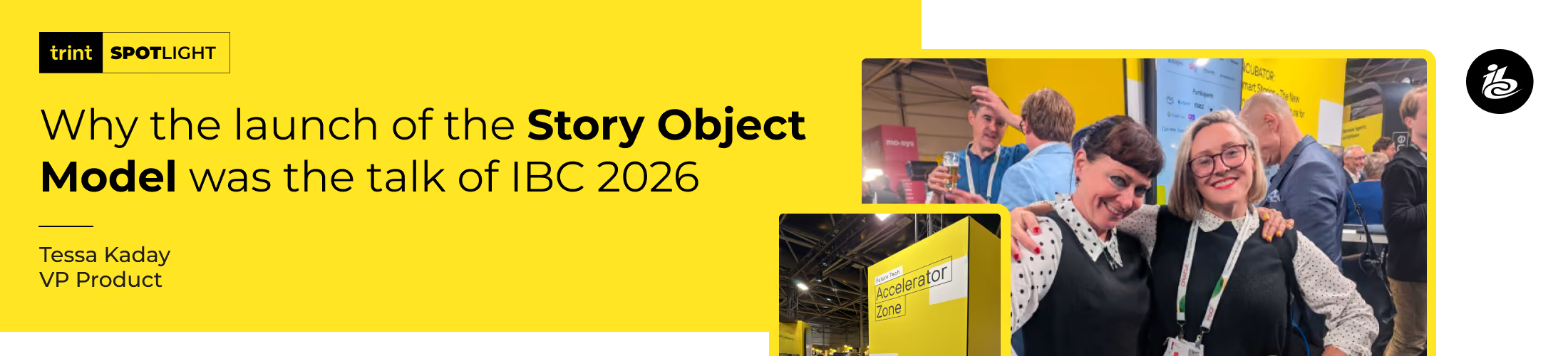
I’m writing this as I recover from IBC 2026 (still slightly sleep-deprived and with the requisite croaky voice) and one message has stuck with me beyond all the other noise: the industry has stopped asking whether or not AI can get jobs done in newsrooms. The conversations that mattered were about the meaty questions: how to make AI workflows reliable, auditable and scalable in real newsroom scenarios and not just at a conference stand. No moment at IBC told that story more clearly than the launch of the Story Object Model (SOM).
We expected interest. 14 Champions and 17 vendors had spent months on this project for a reason. But a standing-room-only crowd for a panel about a data schema told us how widely this project resonated, because it looked to solve a problem that every newsroom knows. A modern news tech stack is made up of dozens of tools – rundown, MAM, graphics, planning, transcription, social – and each holds its own separate picture of the story. When the angle changes, a source is confirmed or legal raises a concern, someone has to carry that update into every system by hand. It's slow, it's where errors creep in, and it gets far riskier once AI agents start acting on that information. An agent that doesn't know the story has changed and will then confidently do the wrong thing. SOM gives every tool one shared, open record of the story – its context, its status and its editorial rules – which each tool can read from and write to.
The champions presenting at the launch – Morag McIntosh, QTV, Jon Roberts, ITN, Brian Hopman, AP, and Alex Bassett, NBCU – took something incredibly complex and made it land, selling both the vision and the detail in under an hour. Then came the demos. Watching the workflows we'd spent months building with the other vendors run live in front of a packed room, and seeing people lean in as they clicked, was pretty thrilling. Going from kick-off to a working multi-vendor story bus in less than six months is fast for any industry standard, and seeing it resonate like that was a moment of real pride.
Another key thing I picked up when walking the show floor: people at IBC this year weren’t impressed by a clever AI demo anymore. Voice commands to edit a video, a slick chatbot – all great, but the conversation has moved on. Anyone can now build something that looks great on a stand. The question everyone was asking instead was: how do I actually operationalize this and make it scalable across my whole business?
Context is the infrastructure. That’s the thesis behind SOM and exactly why Trint wanted to be involved from the start. Anyone who has tried to use any sort of AI tool knows that the quality of the output is totally reliant on the accuracy and depth of the context you give it. It doesn’t matter how good the model, feature or prompt is – bad context, bad results. That’s the piece of the puzzle the industry is focused on and that’s what the Story Object Model is built to solve.
Before the show, I described SOM as doing for the agentic AI era what the MOS protocol did for newsrooms in the 1990s. MOS connected newsroom systems operationally. SOM connects them editorially, so every tool works from the same understanding of the story.
At its heart, it’s deliberately simple: a Story that holds the evolving editorial context, the Assets attached to it, and Tellings: the moment an asset meets a specific audience through a specific outlet. A single language that gives a shared context to every tool a newsroom uses.
This clearly resonated in Amsterdam, and it dominated every conversation I had after the launch. "I was about to launch an internal project to look into this, and now we have somewhere to start." "I can think of so many painful manual processes this could fix immediately." "I want to try a POC of this by the end of the year." I heard all of these from broadcasters who came by for a demo.
During the panel, the champions reminded us all what happens when there's no clear path between tools, and what that friction looks like. It's everywhere in a newsroom, quietly costing time and creating errors, until someone actually connects the systems.
I spent 15 years as a video journalist at Reuters. My last editorial job was running the global live video desk, so I know first-hand what that friction costs when a story is breaking. That's a big part of why Trint wanted to join this conversation early, and built the first working prototype: AI highlights of newsmaking moments published straight to the story bus. It was a moment that really clicked – theory meeting practical application in a way that drove us to get even more ambitious in the run-up to launch.
At launch, Trint was the transcription layer in the demo scenarios. In the Prime Minister resignation announcement, our live transcription turns spoken words into a proposed claim the moment they're said. A journalist approves it, and that one approval triggers everything else: the clip is cut, the right scripts go to air, the held social posts release. AI proposes, the journalist verifies, the system executes.
Before IBC I described what I hoped SOM would unlock for us: live quote monitoring that already knows the story, the editorial guidelines and the key facts that need confirming, with no prompt needed. The PM demo was a first working version of exactly that. It's the kind of editorial technology I could only have dreamed about back on the live desk.
In the demos, you’re not watching one monolithic model do everything. You’re watching six or seven different tools each doing their one job, passing information along a shared bus we’re all on. It’s not a limitation – it’s the whole point. The news organization sets the rules of that bus. They can decide which vendor, which skill, gets access to what, and under their chosen editorial guidelines. Control stays exactly where it should, with the newsroom.
This benefits us vendors too. We don’t have to build a bespoke integration for every broadcaster. Instead, we build a set of capabilities, and organizations choose how they want to use them. A conversation I had with one of our customers summed this up perfectly. They loved our AI highlighting but the real ask wasn’t “can you build a cool feature?” it was “can I get this to work across 10 topics and 100 streams, surfaced exactly where my team already works?” And that’s a scale problem the Story Object Model unlocks.
Two or three years ago, I can remember people walking past our IBC booth and more or less telling us “transcription’s commoditized, you’re done.” I understand why they thought that, but the real value was never the transcription itself – it’s how fast you can find the moments that matter and get it into the hands of the people who need them, in the tools they’re already using. That’s what unlocks value from content before an event is even over. It’s the metadata – speaker ID, word-level timecodes, multilingual capabilities – that all serves one thing. Turning raw footage into something usable, fast and trustworthy. That layer makes audio and video machine-readable from the moment they're captured. In the SOM demos, it's what the other tools on the bus were reading from. And because every claim links back to the exact words and timecode, journalists can verify fast, while the editorial call stays with them.
Getting a deeper understanding of this through our work on the SOM has also changed how we build AI inside Trint. If shared context is what makes agentic tools valuable beyond a proof of concept, then no AI feature we build can be a standalone trick. It has to work for whole teams across thousands of hours of footage, and show up inside the systems newsrooms already run, through our partners' integrations, our APIs and our MCP. When that customer asked for 10 topics and 100 streams, they weren't asking for a better feature. They were asking for exactly this.
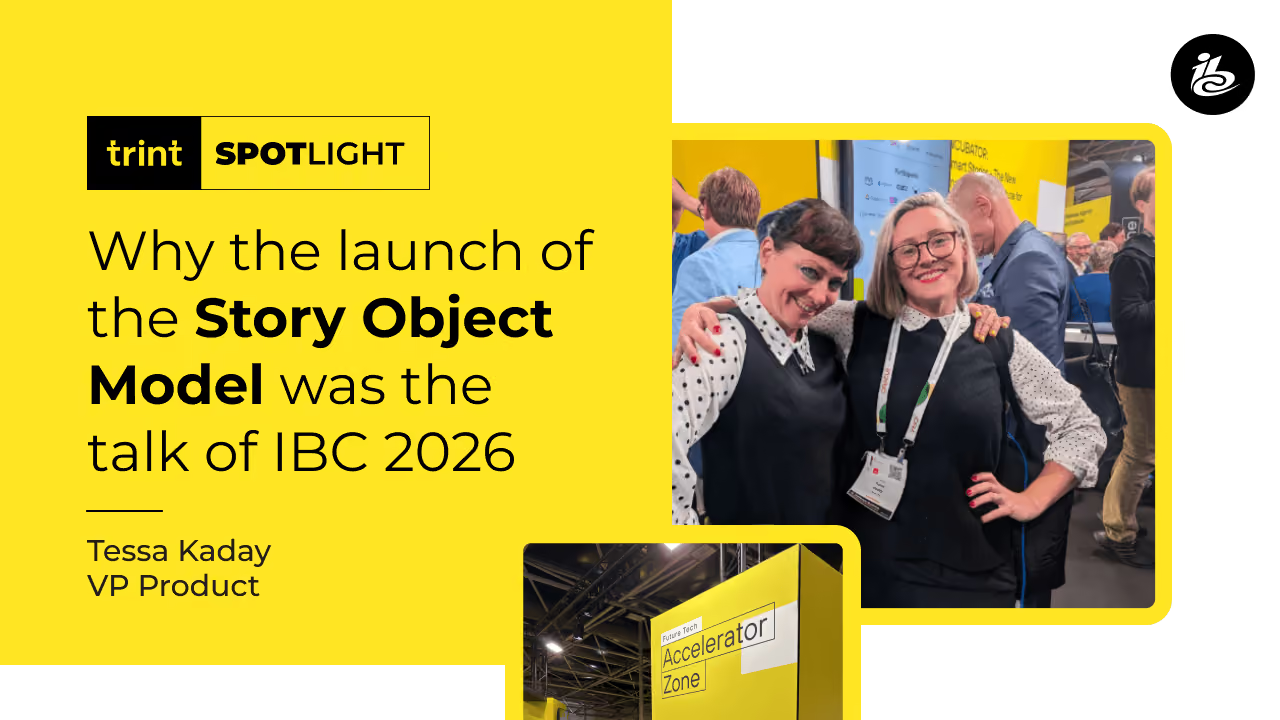
Being part of this project, having those conversations, participating at the Accelerator pod felt truly transformative for me and for Trint. And I don’t think this project is going to stall anytime soon.
SOM 1.0 is published. We’ll keep building on it with broadcasters and partner vendors – and we want more people to join us.
Join in. Try it, break it, feed it all back.
Become part of this project, build a basic integration, tell the team what’s missing, what’s not working. We want it all and we encourage everyone to get involved and join in. You can find all the details on how to join in, over on the Story Object Model website: https://storyobjectmodel.com/
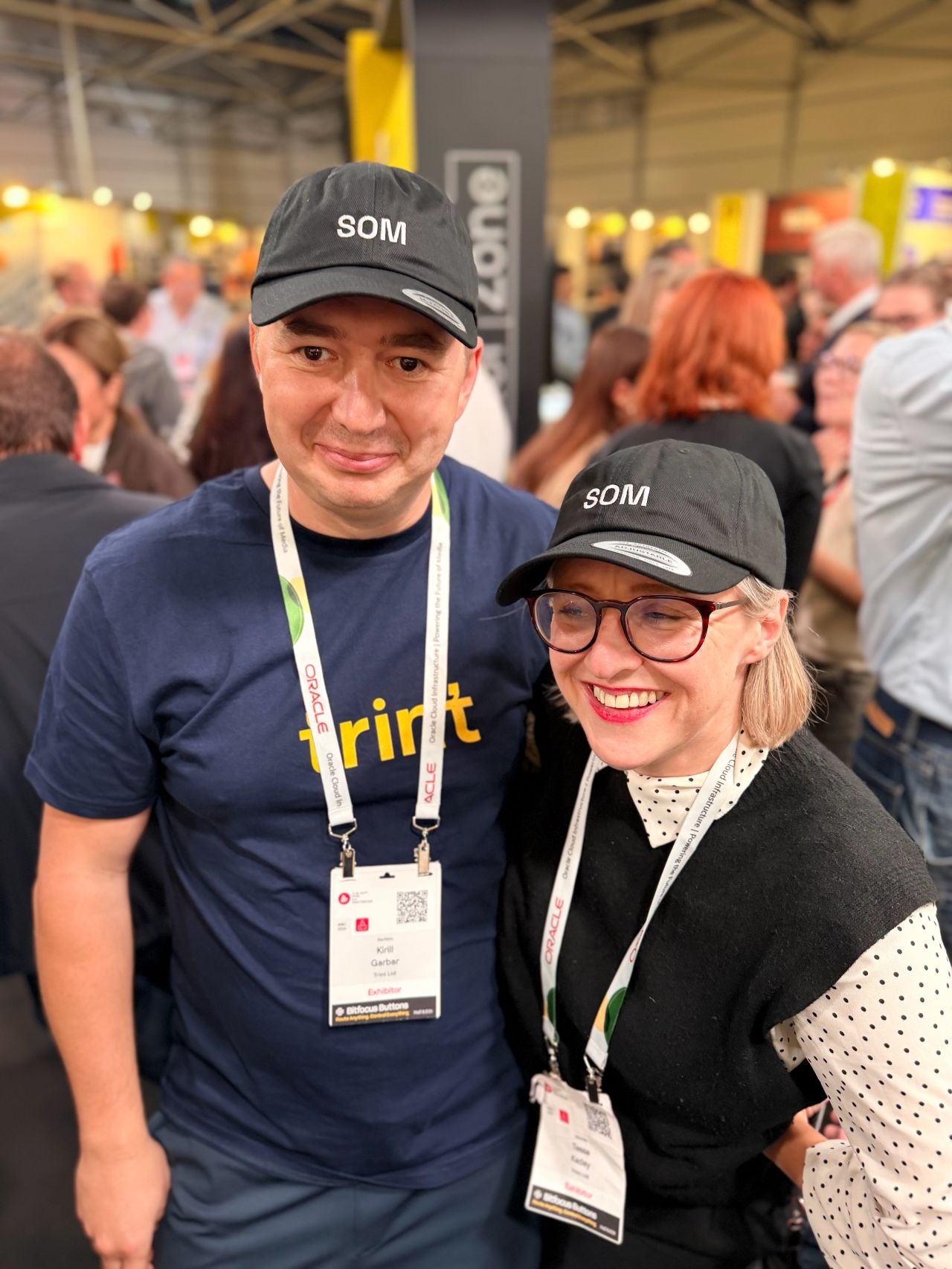
Underneath all the hard work, rehearsals, hackathons, and accidentally matching outfits with IBC organiser, Muki, there was a real joy in joining forces with some of the smartest brains in the business on this project. Working alongside people who are, on paper, customers or competitors, but who spent the weekend acting like a team, because we all believe the problem is bigger than any one of us. That collaborative, slightly chaotic energy is the thing that will stay with me the most. Right with the standing-room-only crowd and my fabulous “SOM” cap.
We built something people needed. Now we get to develop it properly, together.