
The debate isn't about whether AI has a place in the newsroom anymore. Reporters are using it to research, summarize, brainstorm, transcribe and generate ideas. So much so that news organizations are publishing AI policies, investing in tools and experimenting with new workflows.
But there's a gap between just using AI and building AI into the way journalism is done. A journalist asking ChatGPT to summarize a document is AI adoption. A newsroom automatically turning a field recording into a verified transcript, extracting quotes, attaching metadata, translating material and moving it into the production workflow is something different.
It's also about more than moving content between tools. The context around that content needs to move too. Call this the capture-to-publish gap. This is the distance between AI being available to journalists and AI being embedded across the workflow. The latest research suggests that gap is still significant.
In this guide, we'll walk through the fastest way to transcribe an interview and turn it into an article. We'll cover:
- What is the capture-to-publish gap?
- What is actually happening in the newsroom?
- Where does the capture-to-publish gap actually appear?
- Technology isn't the whole problem
- How can newsrooms move from ad-hoc to integrated AI?
- FAQs
What is the capture-to-publish gap?
The capture-to-publish gap is a three-stage model that describes how far a newsroom has progressed from ad-hoc AI usage to assisted processes and fully integrated AI workflows. It's useful because AI adoption isn't binary. A newsroom can have high AI usage while still largely relying on manual processes to do the bulk of production.

Stage 1: Ad-hoc AI
The first step is using AI in an ad-hoc manner. AI tools are available and individual journalists are using them when they find a useful application, but the workflow hasn't fundamentally changed. For instance, a reporter might use a chatbot like ChatGPT to brainstorm interview questions, summarize a report or tidy their notes. There might be plenty of AI activity, but little consistency between teams. Useful processes often depend on individual knowledge.
Signs you're here:
- Journalists choose their own AI tools.
- AI use varies significantly between teams.
- There are few standardized workflows.
- Transcripts, notes and outputs are often moved manually between platforms.
- There's no clear way to measure the impact of AI on production.
Stage 2: Assisted AI
This is when AI becomes part of an established editorial process. Instead of each reporter finding their own way to use AI, the newsroom starts introducing approved tools and repeatable workflows. Manual tasks like transcription, translation and summarization can be accelerated, while journalists retain responsibility for reviewing and approving the output. The technology is starting to save time, but individual tools might still operate independently.
Signs you're here:
- Teams have established AI use cases.
- Journalists receive some guidance or training.
- AI is used for specific production tasks.
- Human review is built into the process.
- Some workflows are faster, but still involve manual handoffs.
Stage 3: Integrated AI
The final stage is fully integrated AI. It's embedded across the entire journey from capture to publication, with source material and the context around it available wherever they are needed.
A recording can become a searchable transcript, while information about its origin, verification status and editorial decisions can remain connected to the wider story.
This is the direction behind emerging approaches such as the Story Object Model, which provides an open standard for sharing story context between newsroom systems. The model distinguishes the story itself, the assets used to tell it and the different ways those assets reach audiences. The aim is to give each tool the same underlying context, rather than requiring every system to reconstruct the story independently. Editorial decisions remain with the people responsible for them.
Signs you're here:
- AI-supported workflows are repeatable across teams.
- Source material can flow between stages of production.
- Journalists and editors work from shared, trusted source material.
- Verification is built into the workflow.
- The newsroom measures AI against meaningful production outcomes.
- AI supports journalists without taking editorial accountability away from them.
What is actually happening in the newsroom?
A fully integrated model sounds like the most efficient solution, but it's rare. AI adoption is near-universal, but usage is very different from integration.
Muck Rack's State of Journalism Report 2026 found that 82% of journalists use AI in the newsroom, with ChatGPT being the most popular tool. That's a substantial level of adoption. But a journalist using ChatGPT on an individual basis is very different from an organization redesigning how it captures, verifies and produces journalism.
Compared with our own report that found 41% of journalists show moderate AI use and only 18% use it extensively, that’s a significant jump in the space of just a year.
Trust is still a major barrier
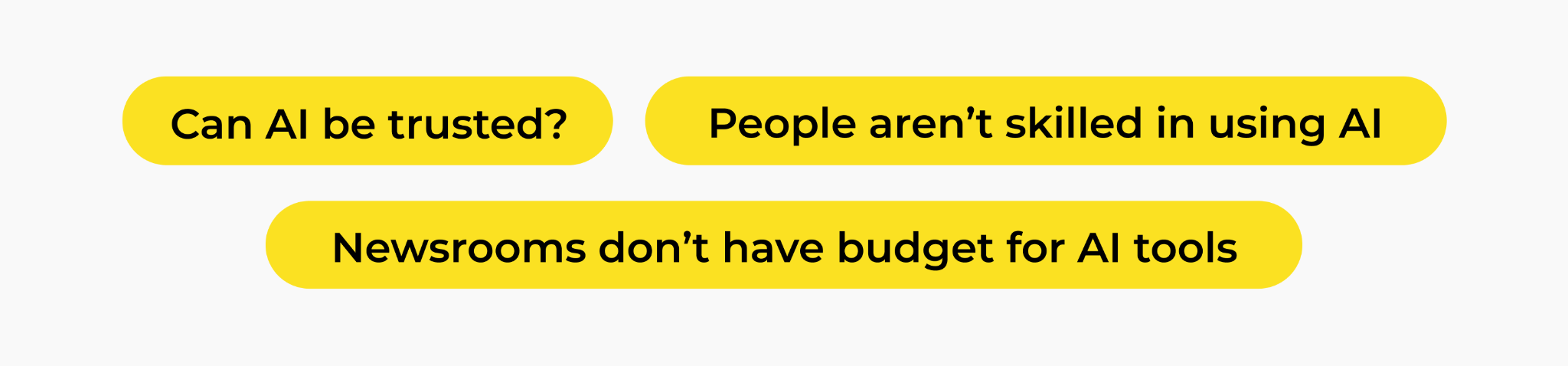
Misinformation is one of the biggest concerns surrounding AI in journalism, and for good reason. Newsrooms are expected to move quickly, but speed can't come at the expense of accuracy. When AI is involved in producing or processing information, journalists also need to know where that information came from and whether it can be trusted.
Data from Cision's State of the Media Report shows just how significant that concern is. 43% of journalists state the impact of AI on journalism was among their biggest challenges. Half of journalists (50%) cite accuracy, fact-checking and misinformation as their biggest worry.
This helps explain why newsrooms can't simply onboard AI to automate more tasks. For journalism, speed only has value when accuracy survives it. A workflow that saves 20 minutes of administrative work but creates uncertainty around a quote, statistic or source hasn't necessarily made the newsroom more efficient. It may simply have moved the work somewhere else.
Data from FT Strategies and WAN-IFRA found that skepticism was one of the biggest barriers to AI adoption for over half (52%) of newsrooms. In other words, the challenge isn't convincing newsrooms that AI exists or that it can be useful. It's building enough trust around how it's used for journalists to incorporate it into their everyday workflows.
Our Future Newsroom report found that 70% of journalists worry about a loss of editorial quality and human judgment when it comes to AI. 65% are concerned about loss of audience trust.
That's why verification needs to be built into the AI workflow, rather than treated as a final check. The most useful applications of AI in journalism aren't necessarily those that make the most editorial decisions. They're the ones that make the source material easier to process while leaving the journalist in control of what ultimately makes it into the story.
Skills & strategy are holding adoption back
Technology isn't the only barrier to adoption. A lack of knowledge and skills among teams is also cited as a major obstacle when integrating AI into the wider workflow.
The FT Strategies and WAN-IFRA report highlights the scale of this challenge, with 61% of newsrooms citing a lack of internal skills or AI expertise as a major barrier to adoption. A further 45% say an unclear view of AI use cases or strategy is slowing progress.
This creates a different kind of adoption gap. The technology might be available, but journalists don't necessarily know where it belongs in their day-to-day work. Which tasks should remain human, and how should AI output be reviewed before it reaches an editor?
Without clear answers, AI can remain something a handful of enthusiastic journalists experiment with rather than becoming part of the wider newsroom workflow.
Closing the capture-to-publish gap therefore requires more than buying the right technology. Newsrooms need to identify practical use cases, give teams the skills to use AI confidently and build clear processes around it. Journalists don't need to be AI experts. The benefits of AI just need to be obvious enough, and the workflow simple enough, that using it becomes a natural part of getting the job done.
AI adoption is happening alongside newsroom cuts
AI adoption is also happening against a difficult backdrop for the media industry. Newsrooms aren't introducing new technology in a vacuum — many are already under pressure to produce more content with fewer people.
Media job cuts reached 17,163 in 2025, up 18% on the year before, according to a Challenger report. This matters when considering how journalists, and the industry as a whole, perceive AI. A tool designed to automate repetitive tasks can look very different depending on whether you're using it to free up time for reporting or wondering whether it could eventually replace your job.
This makes transparency particularly important. Newsrooms need to be clear about what AI is being introduced to do, what remains the journalist's responsibility and how automation is intended to support editorial teams, not replace them.
The opportunity isn't simply to use AI to produce more with fewer people. Use it well and it can take some of the repetitive work out of journalism and give reporters more time for the work that requires reporting, judgment and original thinking. This distinction can make the difference between AI being seen as a threat or a genuinely useful tool.
Where does the capture-to-publish gap actually appear?
The gap becomes clearest when you follow a piece of journalism from the moment information is captured to the moment it reaches the audience. A reporter records an interview. A camera operator captures a press conference. A correspondent sends audio from the field. At that point, the newsroom has valuable source material, but it isn't a story yet. It needs to be transcribed, understood, checked, shaped and turned into something publishable.
This is where disconnected AI adoption can fall short. A journalist might use AI to transcribe an interview, then manually move that transcript into another tool to find quotes, another to translate it and another to draft the story. Each tool might solve an individual problem, but the workflow as a whole remains fragmented.
The capture-to-publish gap lives in those handoffs.
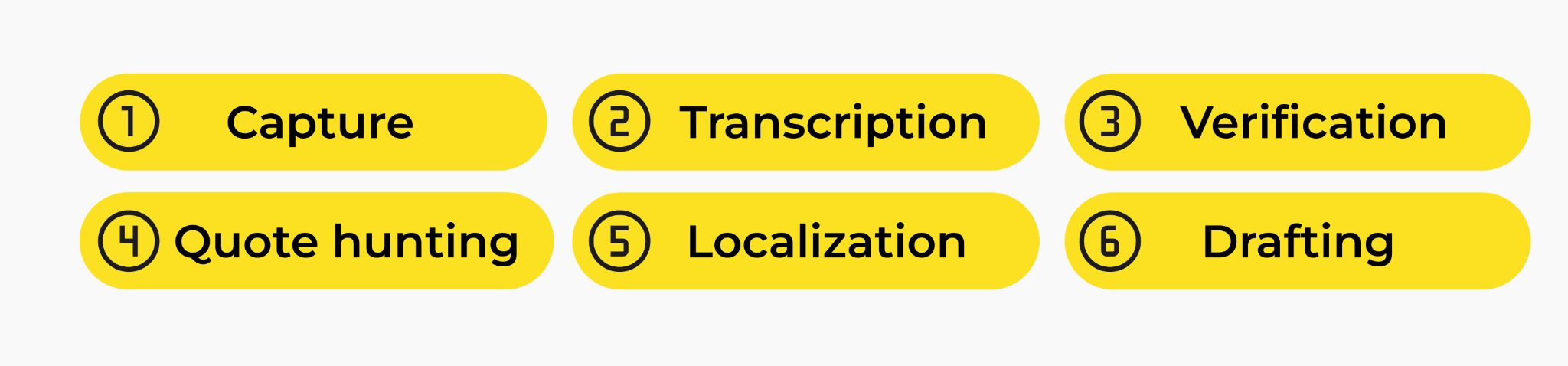
Capture
The first bottleneck appears just after recording. Audio and video are rich sources of information, but they're difficult to search or work with at speed. A reporter may know that an important quote is somewhere in a 40-minute interview, but finding it means listening back through the entire recording and hoping they recognize the right moment when they hear it.
AI transcription can turn that recording into searchable text, giving journalists a much faster way to navigate their source material. But the real opportunity is bigger than simply producing a transcript. Capture should become the starting point for the rest of the workflow.
AFP shows what happens when transcription starts at the point of capture. The news agency uses Trint's live transcription capabilities to monitor events and share transcripts with journalists in real time. During COP28, for example, a reporter could record from their phone outside a meeting while the resulting transcript was shared with the wider team, letting colleagues identify important moments and publish breaking news alerts quickly.
Transcription
Transcription is one of the clearest examples of where AI can remove repetitive work. In an ad-hoc workflow, a reporter might upload an interview to a transcription tool, download the transcript and then start the next stage of the process somewhere else.
An integrated workflow treats the transcript as a working editorial asset. It can be searched, edited, timestamped and reviewed against the original recording, creating a reliable source for everything that follows.
Our Future Newsroom report found that 86% of journalists are currently using AI for transcription, making it one of the most established applications of AI in journalism. The bigger opportunity is connecting that transcription to what happens next.
BILD provides a useful example of this more integrated approach. The German publisher uses Trint alongside its MAM system, Mimir, to bring transcription into its wider media workflow. Rather than treating transcription as a standalone task, the integration helps make information from recorded content available as part of the process of finding, managing and developing stories.
"We can now see interviews transcribed nearly live in the app and immediately use key quotes for online publishing," says Patrick Markowski, Head of Editorial Tech & Operations at BILD. "It all makes us faster. And online, to be fast but correct is most important."
Verification
A transcript isn't automatically a verified record. Names, figures, terminology and quotes still need checking against the original recording. AI can make the process faster by making source material searchable. Timestamps make it easy to find the most relevant point in the recording to verify key quotes in a matter of seconds. The goal isn't to remove the verification layer, but to speed it up.
But verification is about more than checking the words in a transcript. Newsrooms also need to know the context around that information. They need to know whether a quote has been verified, whether a source has been cleared and whether an editor has placed restrictions on how material can be used. This is where approaches such as the Story Object Model become relevant, providing a way for story context to be shared between the systems involved in producing journalism.
Quote hunting
Finding the best quote can be surprisingly time-consuming. A reporter might remember something important was said, but have no idea where it appeared in an interview. A searchable transcript changes that. Instead of scrubbing through the recording, journalists can search for a name, phrase or topic, then jump to the relevant section and listen back to the source. It's a small workflow improvement that becomes significant when repeated across thousands of interviews.
Localization
One interview can become much more than a single article. The same source material might feed a written story, social clip, newsletter, broadcast segment or coverage for another market. When content crosses languages or formats, however, each new version can introduce another round of processing. With a structured transcript as the source, translation, captioning and repurposing content can happen from the same material.
POLITICO offers a useful example of what this looks like in practice. Its European newsroom works across more than 28 languages, with reporters regularly interviewing sources in their native languages before producing English-language coverage. Using Trint, reporters can search transcripts for a phrase they remember and quickly jump to the relevant point in the recording, something Marion Solletty, Editor-at-Large at POLITICO, describes as a "huge time saver".
Drafting
Only after the steps above does the raw material become a story. AI can help journalists summarize source material, identify themes or create a starting point for a draft. But the all-important editorial judgment stays with the reporter and editor — they just reach this stage faster.
Technology isn't the whole problem
It's tempting to look at the capture-to-publish gap as something a better tool can solve. But technology can only take newsrooms so far. The barriers to adoption are also cultural. Journalists need to trust the technology, understand where it fits into their work and feel confident that using it won't compromise editorial standards. If a newsroom introduces AI without addressing those concerns, even a capable tool can struggle to gain traction.
That's particularly important where accuracy and accountability aren't optional extras. A journalist who doesn't trust an AI-generated transcript will still listen back to the entire interview. An editor who isn't confident in an AI-assisted workflow will add additional checks. And a team without a clear understanding of where AI adds value might simply continue working the way it always has.
There's also a difference between giving AI access to information and giving it the context around that information. A transcript might contain an accurate quote, for example, but the wider workflow might also need to know whether it has been cleared or whether an editor has restricted its use.
The answer isn't to ask journalists to embrace AI tools blindly, but to involve them in the process when deciding where it belongs. The most successful adoption is likely to start with practical, low-friction use cases where the benefit is obvious and the journalist remains firmly in control. Transcribing an interview, searching source material or finding a quote can save significant time without asking AI to make the editorial decision itself. Ultimately, integration happens when AI stops feeling like an additional layer of technology and starts solving a problem journalists already have.
How can newsrooms move from ad-hoc to integrated AI?
Not every newsroom needs to be at the integrated stage right away. The more useful question is: where are you now, and what would it take to move to the next stage? The capture-to-publish model provides a simple way to assess that. Think about how your newsroom currently uses AI across the content creation journey.
If you're at the ad-hoc stage, don't try to jump straight into an AI-powered newsroom. Start by identifying one process where journalists repeatedly lose time and establish a shared workflow around it.
If you're working with a lot of video interviews, our guide to scaling video production includes tips for assessing and building your budget based on existing time drains.
If you're already AI-assisted, the next challenge is optimization. Measure what's working, identify new bottlenecks and expand successful workflows without losing the verification and editorial controls that make them trustworthy.
The important thing is that AI maturity isn't measured by how many tools a newsroom uses. What matters is how effectively those tools help journalists move from first word to first draft, without losing accuracy along the way. You want to use AI in the right stages and make those benefits repeatable across the newsroom.

FAQs
Will AI replace journalists?
AI can automate some repetitive tasks involved in journalism, but reporting still requires human judgment, source evaluation, context and accountability. The more useful question for newsrooms is often which tasks AI can support so journalists have more time for reporting and editorial work.
How can AI help with interview transcription?
AI transcription can turn a recorded interview into searchable text much faster than manual transcription. Journalists can then search for names, topics or potential quotes, jump to the relevant timestamp and listen back to the original recording before using the information in a story.
What is a verify-first AI workflow?
A verify-first AI workflow puts source checking into the process rather than leaving it until the end. AI can transcribe, organize or surface information from source material, while journalists verify important details against the original recording before using them in published journalism. You can read more in our guide to tackling misinformation and the verification crisis.
What should newsrooms consider before adopting AI?
Newsrooms should consider the specific problem they want AI to solve, how the technology fits existing workflows, what training journalists need and where human review is required. Clear policies around accuracy, privacy, sensitive information and editorial accountability can also help teams adopt AI with greater confidence.
How can newsrooms measure the success of AI adoption?
Useful measures include time saved on repetitive tasks, production turnaround times, the number of manual handoffs in a workflow and how quickly journalists can find and verify source material. Measuring these outcomes gives newsrooms a clearer picture of whether AI is improving production rather than simply increasing AI usage.
Closing the capture-to-publish gap doesn't mean replacing journalists or getting rid of editorial judgment. It's about removing the manual work that sits between capturing information and doing something useful with it, while keeping the context and decisions that matter connected to the story. That's where Trint fits into the workflow.
Trint helps newsrooms connect the journey from capture to metadata, insights and creation, giving journalists a central place to work with recorded content while keeping verification and editorial judgment firmly in the process.
Want to see how this could work for your newsroom? Book a demo to see how AI-powered transcription and content workflows can help your team spend less time processing source material and more time reporting the stories that matter.




DON'T take our word for it
Download our eBook, Telling Stories Faster With Trint, and hear how Trint is making content creation faster, easier and, most importantly, painless for newsrooms across the world.
Download
How newsrooms are using AI to bridge the capture-to-publish gap
What Is an SRT File & How Do You Create One?