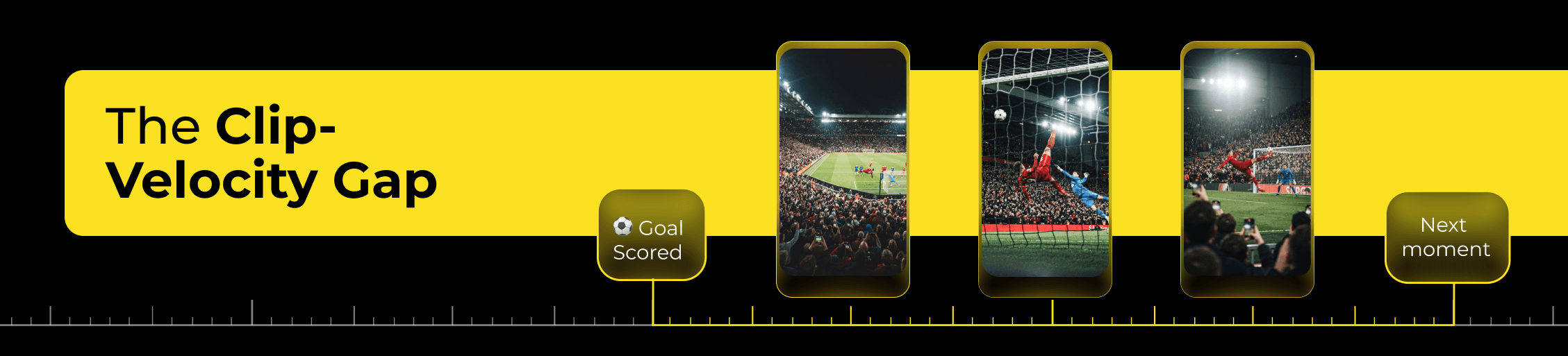
Sports fans don’t wait for the highlights package anymore. They find the moment themselves, within minutes of it happening, on a platform that journalists and sports media teams might not have even published to yet. The production side of the business just hasn't caught up.
This is called the Clip-Velocity Gap: the widening distance between how much clip content fans expect during a match and how much a production team can actually publish inside the window when it still matters. It's less a talent problem or a headcount problem than a structural one, and the data on both sides of the gap is public enough to map.
In this guide, we’ll take you through the Clip-Velocity Gap, get to the root of the issue, and explain how Trint can help.
The numbers
In Deloitte's 2026 Digital Media Trends survey, more than half of fans (52%) say social platforms are their primary way of discovering new content, and that share rises to 73% among Gen Z fans specifically. A large chunk of that same audience, 44%, say they typically discover something on socials and then go elsewhere to watch it in full, which tells you discovery and consumption are now two separate moments, not one.
Second-screen behavior compounds the problem. TikTok's research with Ipsos found that 85% of sports fans use the platform as a second screen during live events, and 94% use it specifically to catch up on highlights they missed. Fans aren't idly scrolling during the match anymore: they're actively hunting for the clip of the moment that just happened, in real time, while the broadcast is still running.
And the audience isn't waiting around for official channels if the clip isn't there. Deloitte's 2025 Digital Media Trends survey also found that a third of Gen Z fans don't subscribe to streaming services for live sports at all, because they get what they need from clips and highlights on social media instead. For a growing share of the audience, the short-form clip has become the only way they consume the broadcast.
That is the demand side. The engagement window this creates is short, usually only minutes long, because the algorithms on every platform reward being first and the fans themselves are already moving onto the next thing.
The Clip-Velocity Gap
The Clip-Velocity Gap is the distance between three numbers, measured for any single match or event:
- Target volume: how many distinct clips, cuts, and formats the moment genuinely justifies, across every platform your audience uses
- Published volume: how many actually go out inside the window that matters
- The engagement window: how long that moment stays worth publishing before the audience and the algorithm both move on
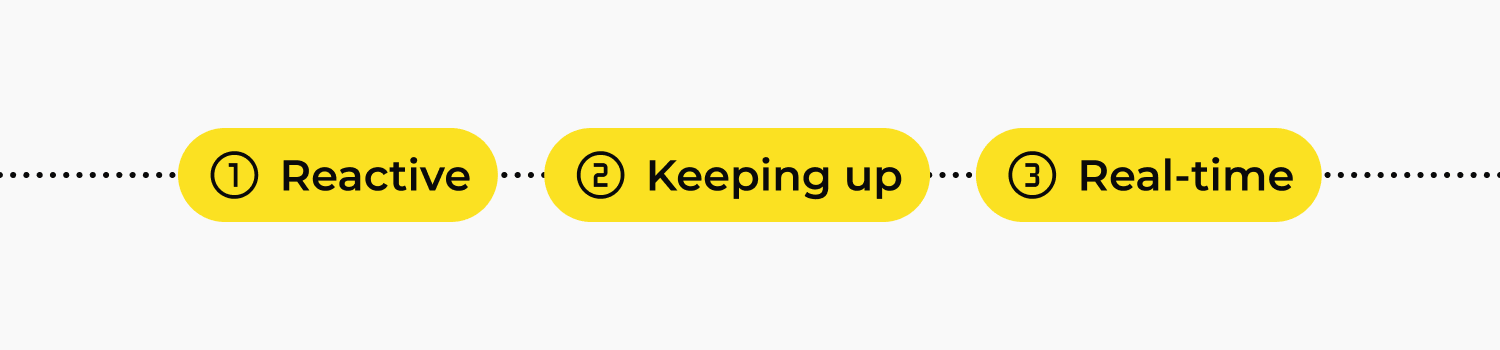
A small gap means your published volume tracks close to target volume, inside the window. A large gap means most of what could have been published either goes out too late to matter or never gets made at all. Most teams sit somewhere on a rough maturity scale between three states:
- Reactive. Content gets made after the fact, once someone has time. Clips go out hours or even a day after the moment, once the audience has already moved on and formed its view of the match from other sources. The team is always working from what remains interesting, not what is most interesting.
- Keeping up. A repeatable process exists. Key moments get identified and published on the same day, sometimes within the hour, using some combination of manual review and lightweight tooling. The gap has narrowed but still exists, particularly for anything that requires translation, multiple platform crops or approval from more than one person.
- Real-time. Production happens in the moment. Live capture, transcription, and quote or highlight identification all run concurrently with the event, so the team is cutting and publishing while the match, presser or interview is still going. The gap is close to zero for the highest-value moments, and what remains is genuine editorial time, not mechanical time.
Very few organizations sit permanently in real-time mode. Most move between keeping up and reactive depending on the size of the event and how many things are happening at once. The scale is more diagnostic than a grade, and you can use our self-scorer to help place your own team on it.
The evidence
None of the individual stats above are new. What is worth pointing out is how consistently they point at the same structural mismatch when you put them side by side.
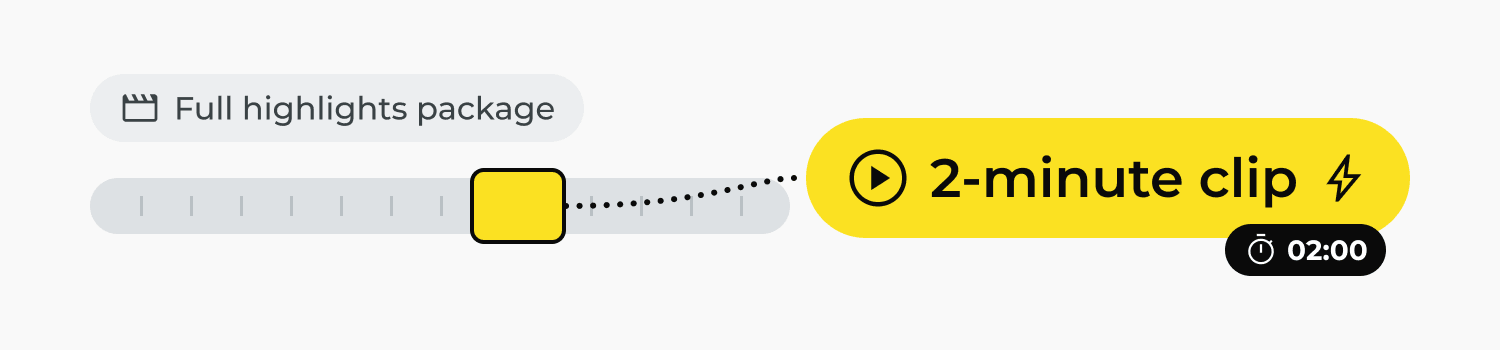
On the demand side: fans discover on socials first, use a second screen actively during live events rather than passively and an entire generational cohort now treats social clips as a substitute for a live sports subscription, rather than a companion to it. Separately, WSC Sports' 2025/26 fan engagement research found Gen Z is 71% more likely than Gen X, and 39% more likely than Millennials, to choose a short clip of two minutes or less over a full highlights package. The audience has developed a structural preference for short-form over long-form, and for the platform over the official channel.
On the supply side, sports rights-holders are aware of the gap and are already trying to close it with volume. WSC Sports reports that rights-holders are producing two to ten times more content than in prior years to keep pace. Case studies from its broadcast partners describe per-clip turnaround falling from roughly 15 minutes down to a matter of seconds, and full match-recap turnaround falling from around two hours to five or ten minutes, entirely through automation rather than added headcount.
That last point matters more than the specific numbers. When a vendor's own case studies show 8 to 10 times improvements in turnaround coming from workflow automation rather than staffing increases, that is a reasonable proxy for how far manual production has fallen behind what the moment now demands. It also lines up with Stats Perform's 2026 survey of 675 sports media executives, in which 81% said they had expanded their use of AI in the past year specifically to gain efficiency and cut costs, and where increasing content volume was cited as the leading reason for adopting AI at all.
Put together, the picture is not "fans want more content and teams are slow." Fan behavior has already shifted to a short-form, multi-platform, real-time default, and production workflows built for a single-channel, post-match world are structurally unable to match that pace without changing how the work itself gets done.
Why this is structural, not a staffing problem
It is tempting to read a gap like this as a resourcing question. Hire two more editors, add a social producer, and the gap closes. In practice, that approach hits a ceiling fast, for a few reasons that are worth naming directly.
- The bottleneck is usually not editing but finding. Locating the right ten seconds inside 90 minutes of audio or video, especially across multiple languages or overlapping speakers, is the slowest part of the pipeline in a manual workflow. Adding editors doesn't fix a search problem.
- Volume and speed are both required at once. The gap has two dimensions, not one. A team can hire its way to higher volume over a season. It generally can't hire its way to a five-minute turnaround on every match, every week, because that requires the underlying process to run faster, not just more often.
- Multi-format and multi-language multiply the work linearly. Every additional platform crop and every additional language is roughly another full pass through the content for a manual team. That scales headcount in direct proportion to ambition, which is expensive and slow to build.
- The event doesn't wait for hiring cycles. A tournament, transfer window or breaking story creates a short-term spike in required volume that no realistic headcount plan is built to absorb, because building for peak demand means paying for idle capacity the rest of the time.
This is why the organizations moving toward real-time maturity are doing it primarily through workflow automation. Rather than hiring more people to speed up manual tasks like finding, transcribing and translating content, they’re using automation to make the entire process more efficient. The Stats Perform data above points the same way: efficiency and cost, not simply "more staff," is what is driving AI adoption across the industry right now.
What automation doesn't fix
None of this closes the gap on its own, and it is worth being honest about where the limits sit.
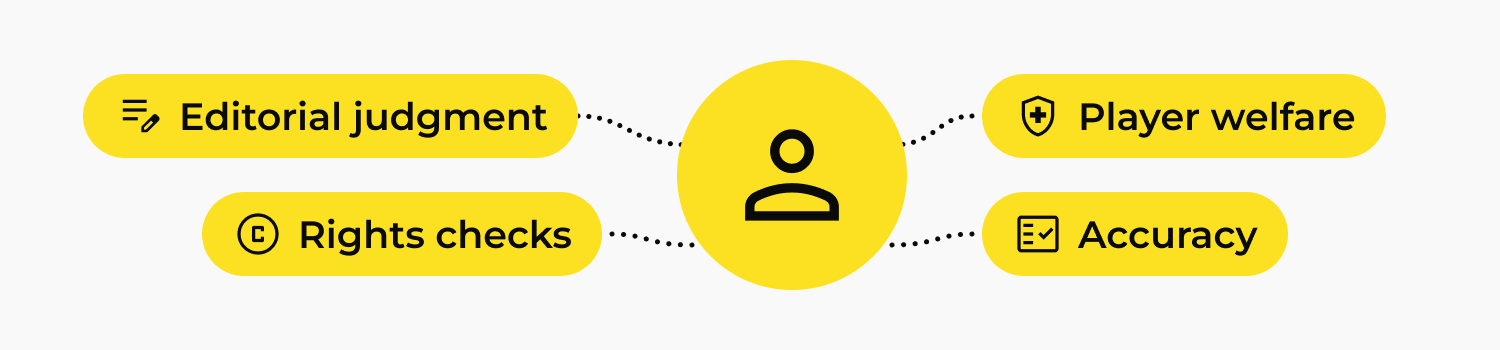
- Editorial judgment doesn't scale. Deciding which quote leads a story, which moment represents the club or league fairly and which clip is simply not appropriate to publish, regardless of how compelling it is, remains a human call. Faster tooling gives editors more time to make that call properly. It doesn't make the call for them.
- Rights and clearance are unchanged by speed. Broadcast rights, image rights and any embargo attached to an event apply exactly the same whether a clip takes five minutes or five hours to produce. A faster pipeline that skips clearance isn't a faster pipeline. It is a liability.
- Player welfare and relationship management still require a person. A press officer managing an athlete's ongoing relationship with media is weighing tone, context and consequences that a highlight-finding tool has no visibility into.
- Accuracy still needs a check. Any automated transcription or translation step should be reviewed before it becomes a published quote. Even at up to 99% accuracy, the small remainder matters more in sports, where a misquoted manager or player becomes its own story.
Automation handles the mechanical work involved in searching, transcribing and reformatting content. That gives people more time to focus on the editorial and legal decisions that still require human judgement.
How to close the gap with Trint
Closing the mechanical side of the Clip-Velocity Gap starts with removing the slowest step in a manual workflow: finding the moment inside the recording. Trint's Live Capture ingests a feed directly from the camera covering a match, presser or interview and produces an editable, searchable transcript in as fast as three seconds.
From there, AI Highlights (in both live and batch modes) and the AI Assistant surface the quotes and moments most likely to matter, while a human still approves every one. The Trint MCP Connector makes Trint files easily accessible, right where you’re working in your chosen AI Agent, letting you search for those quotes without leaving your LLM. The Caption Editor and support for translation in more than 70 languages handle the multi-format, multi-language multiplication without a separate pass for each output.
And for teams building longer pieces from multiple sources, Story Builder pulls quotes across transcripts into one narrative, ready to export for an article, podcast or video edit.
Where does your team sit? A short self-scorer
Score your team's most recent significant matchday or event on each line, then total it up.
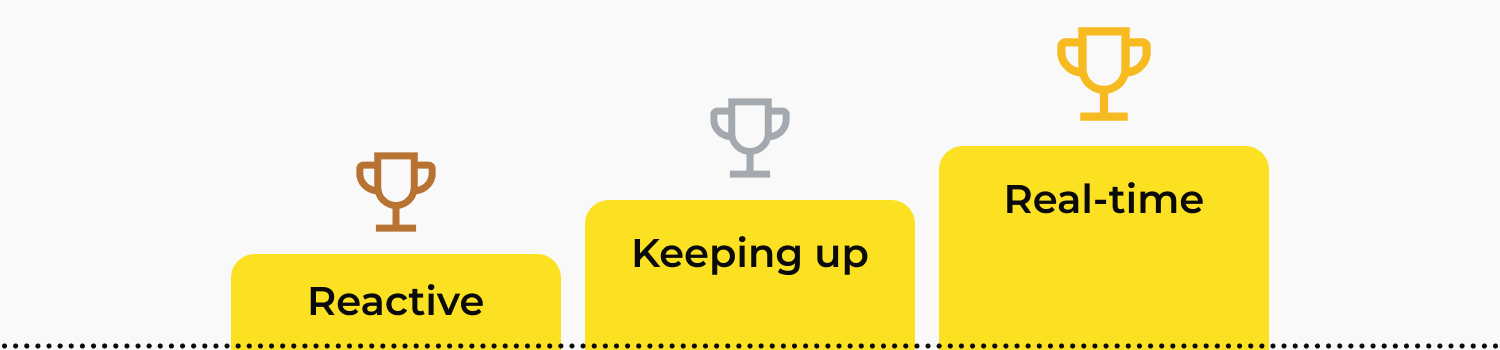
5 to 7 points: Reactive. The team is working from what remains interesting once time allows. The biggest single fix is usually removing manual transcription and search from the critical path, since that is where most reactive teams lose the most time.
8 to 11 points: Keeping up. A repeatable process exists and mostly holds up for single events. The gap tends to reopen during multi-language content or during weeks with more than one significant event at once.
12 to 15 points: Real-time. Most of the gap is closed for the moments that matter most. What remains is worth protecting deliberately, since real-time production increases the temptation to skip the editorial and rights checks in Section 5 that shouldn't be skipped.
Clip-velocity FAQs
What is the Clip-Velocity Gap?
It is the distance between how much clip content a moment justifies, how much actually gets published inside the window when it still matters and how long that window lasts. It is a way to measure whether a team's production pace matches current fan behavior, not just whether it produces a lot of content.
Is the Clip-Velocity Gap mainly a staffing problem?
No. It is a structural mismatch between manual, single-pass production workflows and a fan base that now expects short-form, multi-platform, near-real-time content. Adding headcount can increase overall volume over time, but it doesn't reliably fix turnaround speed, which is the other half of the gap.
Does closing the gap mean removing human editorial control?
No. The evidence points to automation closing the mechanical bottleneck, mainly finding and transcribing content fast enough, while editorial judgment, rights clearance and relationship management stay firmly with the people doing the job. Speed without those checks is a liability, not an improvement.
How do I move my team from "keeping up" to "real-time"?
Most teams stuck at "keeping up" are still losing time to manual search and translation rather than to the actual cutting or publishing steps, so that is usually the first place to look. Tools like BulkScribe allow you to turn large volumes of audio and video into a fully indexed, searchable archive, so you can quickly track down standout quotes or highlights using AI Assistant.