
Conversations around AI in business are naturally dominated by cost savings, monetization, and competitive advantage. Ask senior leadership and they’ll likely frame it as a financial instrument. But what happens when you ask the people actually doing the work - the journalists and newsroom professionals in the trenches - what they are most optimistic about?
The data is telling. It suggests a powerful shift in perspective, moving from the purely economic to the deeply human and purposeful. In fact, when we recently asked newsroom professionals about their greatest optimisms for GenAI in the newsroom, the data revealed that they’re looking to AI not for financial benefit, but rather for professional fulfillment.
It got us thinking back to Dan Pink's ‘Motivation 3.0’ model from his book “Drive” (a fascinating read if you’re not familiar), where he asserts that true engagement and high performance are driven not by external rewards (think carrot and stick), but by three innate human needs: autonomy (the desire to direct our own lives), mastery (the urge to get better at something that matters), and purpose (pursuing something larger than ourselves).

And the results of our study show that newsroom professionals see AI as the ultimate tool for achieving these three needs, relegating traditional business metrics to secondary concerns.
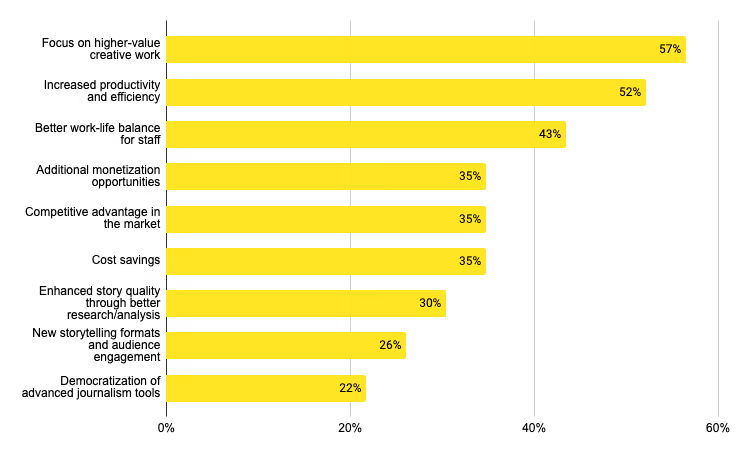
When asked to flag their greatest optimisms around AI's potential for their newsroom, the results were striking. Focus on higher-value creative work (57%), efficiency gains (52%), and better work-life balance (43%) made up the top three benefits.
Compare these "human-centric" motivations to more traditional business advantages such as additional monetization opportunities, competitive advantage, and cost savings - all lagging behind at 35%.
It suggests that newsroom professionals aren't primarily interested in AI as a money making (or saving) tool; they’re interested in it for professional liberation. After all, journalists entered this world to tell important stories, connect with audiences, and produce impactful, creative work. They did not enter it to spend hours transcribing, manually cleaning datasets, or slogging through repetitive tasks.
Nor did they aspire to become overwhelmed and burned-out with little control over their workloads. So it’s no surprise that they see AI as a means to restore that control - by dialling up their productivity, in turn reducing the late nights and overwhelming pressure that comes with modern news cycles. Better work-life balance is not a perk; it’s a prerequisite for sustainable autonomy and creative thinking.
In this view, AI is the digital assistant that frees them from the "drudgery tax," allowing them to double down on the parts of their job that require uniquely human skills of empathy, judgment, and original thought. It’s a mechanism for greater autonomy, achieving mastery in the craft and fulfilling the wider purpose of journalism.
The research challenges the common narrative around AI. Its greatest potential is not simply to shrink the budget, but to expand human potential.
When newsroom professionals see AI, they don't necessarily see a threat to their job; they see an opportunity to be more human. For any organization implementing AI, the focus needs to shift from a purely financial ROI to one that incorporates a form of human ROI. By framing AI as an amplifier of human creativity and a healthier work-life balance, news organizations can ensure successful adoption and, critically, happier and more fulfilled staff who produce consistently high-quality, high-value work that delights audiences.