In the digital newsroom, transcription tools generally fall into two categories: "utilities" and "workspaces." A utility is something you feed a file into, and it spits out a result. A workspace is where you actually craft the story.
When comparing Trint and Sonix.ai, you are looking at the best of both worlds. Sonix.ai is widely regarded as one of the most accurate transcription "utilities" on the market; a powerhouse for processing and transcribing data. Trint, however, connects the wider newsroom workspace - designed specifically for the chaotic and collaborative workflows of journalism and media.
For news directors and sports producers deciding between the two, the choice depends on where and how your team spends their time.
News doesn't happen at a desk. It happens out on the scene, in press conferences, or at global summits.
Sonix.ai is a web-first platform. It’s excellent for processing files you have already recorded. However, it lacks a dedicated mobile app that integrates seamlessly into a transcription workflow. To use Sonix in the field, you typically have to record on a voice memo app, export the file, and upload it to the Sonix browser interface.
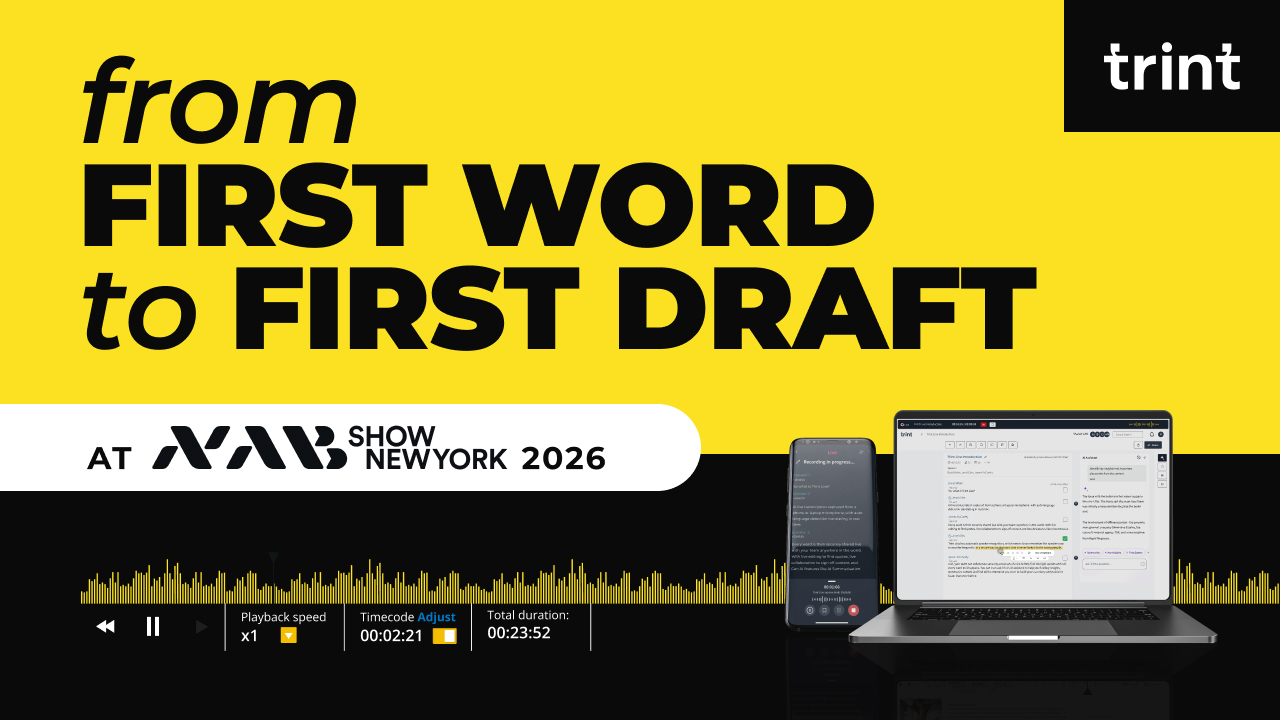
Trint not only works on web and desktop, but also has a dedicated mobile app that enables a reporter to transcribe live on their phone while the interview or press conference is still happening. And the live transcript is ready for remote collaborators to verify, fact check and edit as it appears on screen - all while the conversation is taking place. Tottenham Hotspur FC - the English Premier League icon - use Trint’s mobile app to do so much more on the move.
The Verdict: Sonix is fine if you are desk-bound. But for reporters and field journalists who need to capture, transcribe, verify and publish as in one motion and as quickly as possible, Trint’s live capabilities on all platforms makes it the most suitable choice.
In a breaking news scenario or a post-game scramble, multiple people need access to the same assets instantly.
Sonix.ai has good sharing features. You can share read-only links or grant editing access to files. It works well for a standard review process where one person reviews a file and then passes it to the next.
Trint operates more like a live Google Doc. Live transcription (complete with automatic language detection for mulit-lingual events) comes with real-time verification and fact-checking, collaboration and editing. Imagine a press conference is happening live. With Trint, the transcript is appearing on the screen in real-time for the rest of the team. A colleague on the scene can be playing back and verifying quotes, a Producer in London can be extracting key insights and and time-stamped soundbites, all while a writer in New York is pushing those quotes into their CMS and a video editor is pulling the corresponding clips - all simultaneously, on the same live stream. This is how AFP (Agence France-Presse) used Trint at the COP 28 summit in Dubai..
The Verdict: Sonix is a solid repository. Trint is a live newsroom. For high-pressure media environments where seconds really count to capturing your audience and satisfying 24/7 news cycles, Trint’s real-time collaboration, fact checking and editing is unmatched.
Newsrooms operate a nuanced tech stack with popular news production systems (NPS), media asset managers (MAM) and video production solutions - like Mimir, Saga, Octopus NRCS, LiveU, and AP ENPS.
While Sonix.ai offers integrations with popular collaboration apps and video conferencing tools, there’s currently no interoperability with specialist news and media apps, meaning users urgently stressing to get content out are stuck in a clunky rigmarole of tab hopping, exporting and reimporting files just to publish the latest story.
Conversely, as well as integrating with popular collaboration apps, Trint co-exists with the tools your journalists already use, meeting them where they work rather than cornering them into siloed, disconnected loops. By seamlessly connecting to your existing media tech stack, users can avoid the tab hopping and find transcripts automatically indexed within your MAM, or drag-and-drop an asset into a story within your NPS, and even transcribe live video within Trint and your NPS in real time. BILD, Europe’s largest newspaper by circulation, has streamlined storytelling by integrating Trint with Mimir - its MAM.
The Verdict: If you need a reliable, accurate transcription tool that links with your general workflows, Sonix is a good choice. However, for news and sports media teams under pressure to meet super tight deadlines and publish stories faster, then Trint’s ability to harmoniously synchronize with existing news and media tools and meet users where they work makes it the more suitable option.
It is important to address the cost, as this is often one of Sonix’s biggest strengths.
Sonix.ai offers a highly flexible, pay-as-you-go model that is often more affordable for freelancers or teams with inconsistent volumes. Their accuracy-to-price ratio is arguably one of the best in the industry.
Trint is a premium, subscription-heavy product. It is built, and therefore priced, for the enterprise. Organizations are paying for the wider ecosystem - the mobile app, the live collaboration, the seamless integration with existing apps, the ISO-certified security and data privacy frameworks, not to mention the deep content creation tools.
The Verdict: If you just require a transcript that might need summarizing, Sonix is the better deal. But news and sports media teams aren't buying transcripts; they are seeking faster workflows, efficiency and content velocity. Trint’s higher cost is justified by the hours of labor saved in the "field-to-edit" workflow.
Choose Sonix.ai if:
Choose Trint if:
Ultimately, Sonix is a fantastic transcription engine - perhaps the most accurate one available. But Trint is a media production partner. For newsrooms and sports media where the story is evolving by the second, Trint is the tool that keeps up.