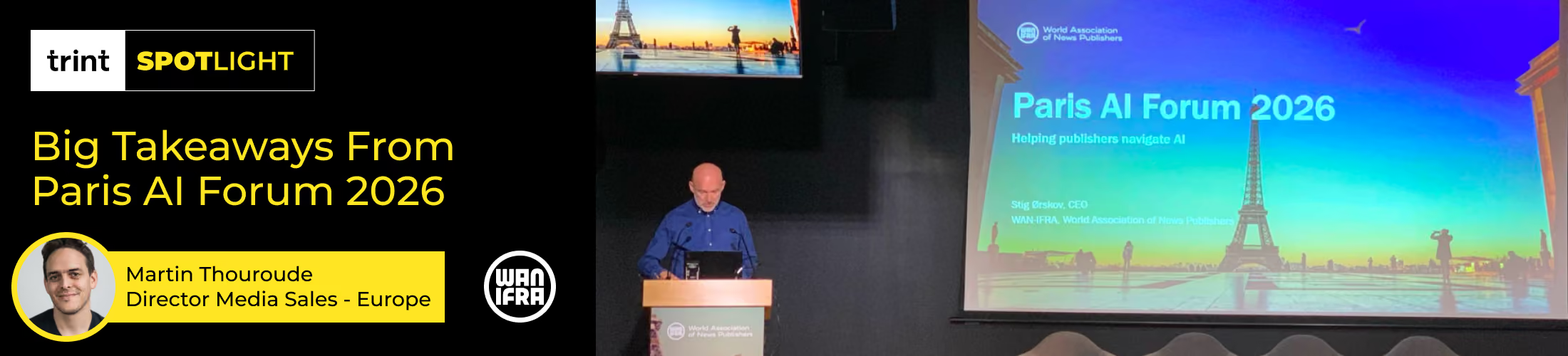
Fresh off IBC 2026, I made my way to Paris for the 2026 WAN IFRA Paris AI Forum – my second time at the event, following the 2024 edition in Copenhagen. Trint sponsored this year’s edition, held at the Les Echos–Le Parisien Group auditorium, and I came back with a different perspective on where news publishers currently stand with AI, along with some valuable learnings for us.
This year’s event pulled a genuinely strong crowd with 176 attendees, 32 speakers, and 12 sponsors from 22 countries. And what struck me most about this event, wasn’t the scale so much as the format. Compared to a show like IBC, where thousands of people move through a sprawling floor, WAN-IFRA keeps things tight enough that you can actually have conversations that matter, rather than working the crowd. Plus, that quality face time is what makes an event like this worth the trip, and it’s part of why we sponsored.
The most consistent theme I ran into was how many print-first newsrooms have already solved the transcription part of the problem internally, often with lightweight tools built in-house using models like Claude Code. A journalist uploads a file, gets a transcript, and moves on. It's a solitary, single-user workflow, built to answer one question: what did they say? It isn't designed to help a newsroom do more with what it captures: share it across a team, turn it into multiple pieces of content, or feed it into the next story. That's the real gap. These organizations are dealing with genuine budget pressure and headcount cuts, so an internal script feels like it has solved the problem. But it has solved transcription, not editorial capacity, and some of the people I spoke to hadn't yet made that distinction.
That's a different picture from broadcast-heavy events like IBC, where organizations already run tools like LiveU and other broadcast infrastructure, and where live transcription and integrations resonate naturally because the workflow is already collaborative by necessity. For text-first publishers, the opportunity is less about proving capability and more about reframing the conversation: not "can you transcribe this," but "what happens to this conversation once the transcript exists."
Two sessions I found particularly interesting were “Valuing 70 years of Archives: Building an AI Archive Engine” and “Building Products from Your Assets.” Both were built on a premise we stand by at Trint, that a newsroom’s back catalogue isn’t dead weight, it’s an under-leveraged asset, willing to be utilized. The publishers leading the charge here aren’t just digitising old audio and video for storage purposes, they’re turning decades of archive footage into searchable, shareable, revenue-generating content. That’s exactly what BulkScribe is built to address so it was great to hear the room treating archive strategy as a genuine product opportunity.
A recurring topic across sessions at WAN IFRA was the idea that publishers now serve two audiences: the traditional human readership and the ever-growing “AI audience” of bots and agents consuming content on their behalf. Some speakers even suggested these could eventually outpace human traffic.
Alongside that, there was a strong emphasis on human-in-the-loop designed workflows, as seen in the “Beyond AI Tools: Reinventing Media Organization” session. I saw workflows presented which mapped out seven or eight steps with specific checkpoints where a human review was mandatory, not optional. This also made me think about the recent launch of the Story Object Model (SOM) at IBC and how the principle there is the same – define exactly where a human needs to check the AI output, not whether they do it all. It’s the same thinking behind how we’ve built AI Highlights, every suggested quote comes with the reasoning behind it and an accept or reject step before it goes anywhere.
One of the key things I heard that stayed with me after leaving the event, was that AI tools are empowering newsrooms to report stories that would otherwise have been impossible to pursue.
The wider point behind this is all about time. While AI might save a journalist a few hours a week, the real value is what that time gets reinvested in. The consensus in the room was that commoditized, general news is already automatable and increasingly worthless as a differentiator. Real survival in the industry depends on original investigative work that can’t be replicated elsewhere. We know that AI helps with quantity and speed, but quality and originality remain the actual reason readers subscribe and keep reading.
My biggest takeaway compared to my last visit to this event (just two years ago) is that the conversation has moved on from “should we be testing AI” to “this is already embedded in how we work.” Newsrooms are actively building internal tools, training staff, and pushing adoption, with a growing sense that those who don’t engage, risk being left behind. There’s also the pace of new models and tools that can be exhausting, and it makes it tricky for even internal “AI power users” to stay strategic rather than reactive.