In the high-stakes world of news and sports media, transcription software is no longer just a convenience; it’s infrastructure. The ability to turn audio and video into searchable, editable text instantly isn't a luxury; it's how compelling stories get broken before the competition.
Two names often dominate the conversation for enterprise-level transcription: Trint and HappyScribe. Both are powerful tools that have moved far beyond simple speech-to-text, but they serve different masters.
For media teams trying to decide between the two, the choice usually comes down to a single question: Do you need a transcriptionist, or do you need a workflow?
Here is how they stack up for the specific demands of news and sports cycles.
Both Trint and HappyScribe represent the best in converting speech to text. However, they each serve a very different purpose.
HappyScribe is a multi-lingual "AI note taker" that integrates with Google Meet, Microsoft Teams and Zoom, while you can connect your Microsoft Outlook or Google Calendar to automate meeting notetaking. So if you’re in back-to-back meetings or need the summary of actions needed to close the next big sale, you wouldn’t go wrong with HappyScribe.
Meanwhile Trint helps you create content; not manage meetings. As well as being founded and built by journalists, it integrates with news production systems, MAMs and live video broadcasting tools to streamline newsroom workflows and meet journalists where they work. Customers such as BILD have successfully connected Trint to a wider newsroom technology ecosystem to automate workflows and work even faster.
In sum, Trint isn't there to summarize your meeting; it’s ingesting the raw footage from the press conference so your team can draft and - importantly - share the story before anyone else.
Verdict: If you need a record of who’s owning which actions from the latest team sync, HappyScribe is there to help. If you want to take a soundbite from a post-game interview and have it ready at lightning speed for the next bulletin, then use Trint.
For sports desks and breaking news teams, "live" is the only time that matters.
HappyScribe is primarily a reactive tool. Its strength lies in uploading existing files (video or audio) and transcribing them after the fact. For example, its subtitling suite is impressive, complete with a visually intuitive editor that makes it easy to burn captions directly onto video. If your primary output is social media video clips that need accurate hard-coded subtitles, HappyScribe has got your back.
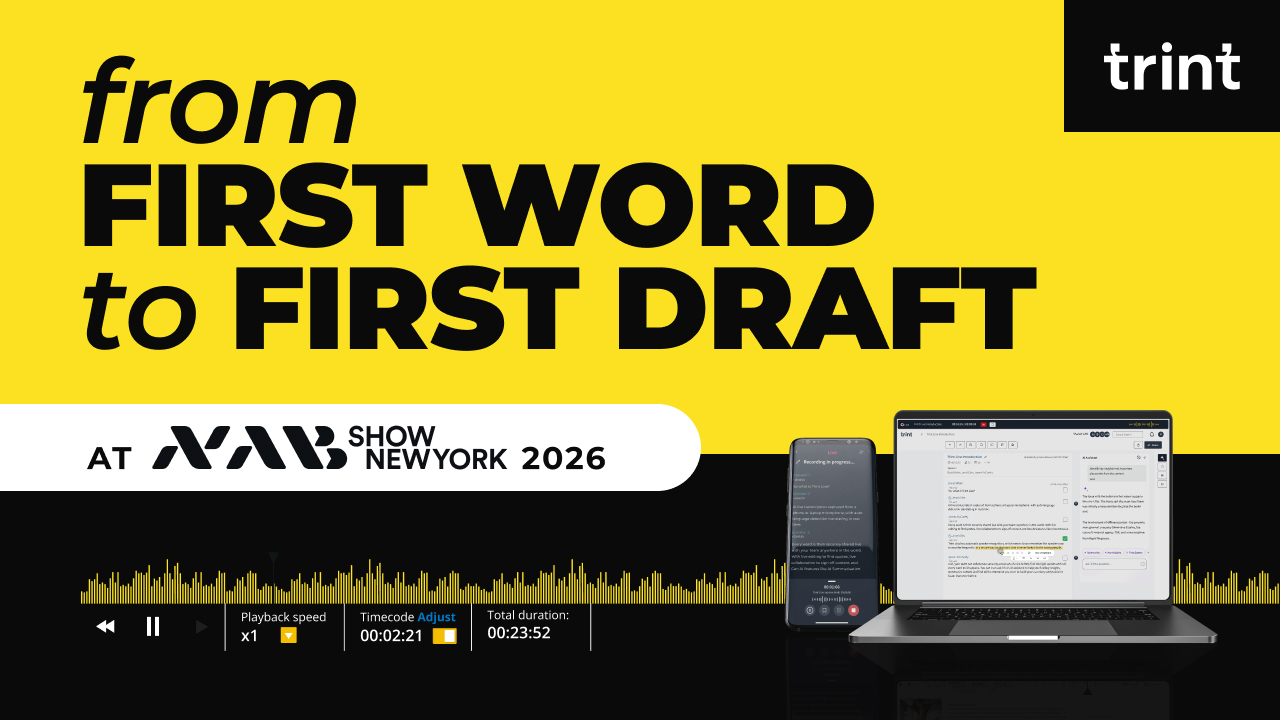
However, Trint shines in the moment. Our live transcription allows teams to transcribe a live broadcast feed or a press conference in real time. Crucially, this feed is collaborative. A reporter in the field can be recording an interview on the mobile app while an editor in the newsroom watches the text appear instantly, rewinding, playing back, verifying and editing as the interview is happening. They can highlight quotes and start the rough cut before the interview’s wrapped up. This is how Agence France-Press (AFP) used Trint at COP28 in Dubai.
Verdict: If you can afford to wait until the file is uploaded, HappyScribe will give you what you need. But for sports media covering live press conferences or newsrooms breaking stories as they happen, Trint’s live capability is an operational advantage.
No AI is perfect. How these platforms handle the "last mile" of accuracy is a major differentiator.
Trint is an AI-first platform, while we insist on keeping a human in the loop via a robust editor so you can correct the AI’s mistakes. AI does the heavy lifting, but you have the tools to verify and fact check.
HappyScribe offers a hybrid model. They provide automated AI transcription, but they also offer an up to 100% human transcription service. If you have legal footage or an archive interview with difficult audio that must be perfect, you can pay an additional fee to have a human at HappyScribe type it out - as long as speed is not a requirement.
Verdict: For absolute precision on difficult audio without lifting a finger, HappyScribe’s human service is highly valuable. However, for newsrooms where speed beats 100% perfection, Trint’s AI is fast enough to get you more than 90% of the way there, and the live editor is easy and slick enough to quickly fix the rest.
Happy Scribe is an excellent tool for:
Trint is the appropriate engine for:
Ultimately, Happy Scribe is a great service for converting audio to text. Trint, however, is a workspace for creating content from that text. For fast-paced media environments, that distinction makes all the difference.